
The Problem With Giving Tuesday: Noise, Fatigue, And Burnout
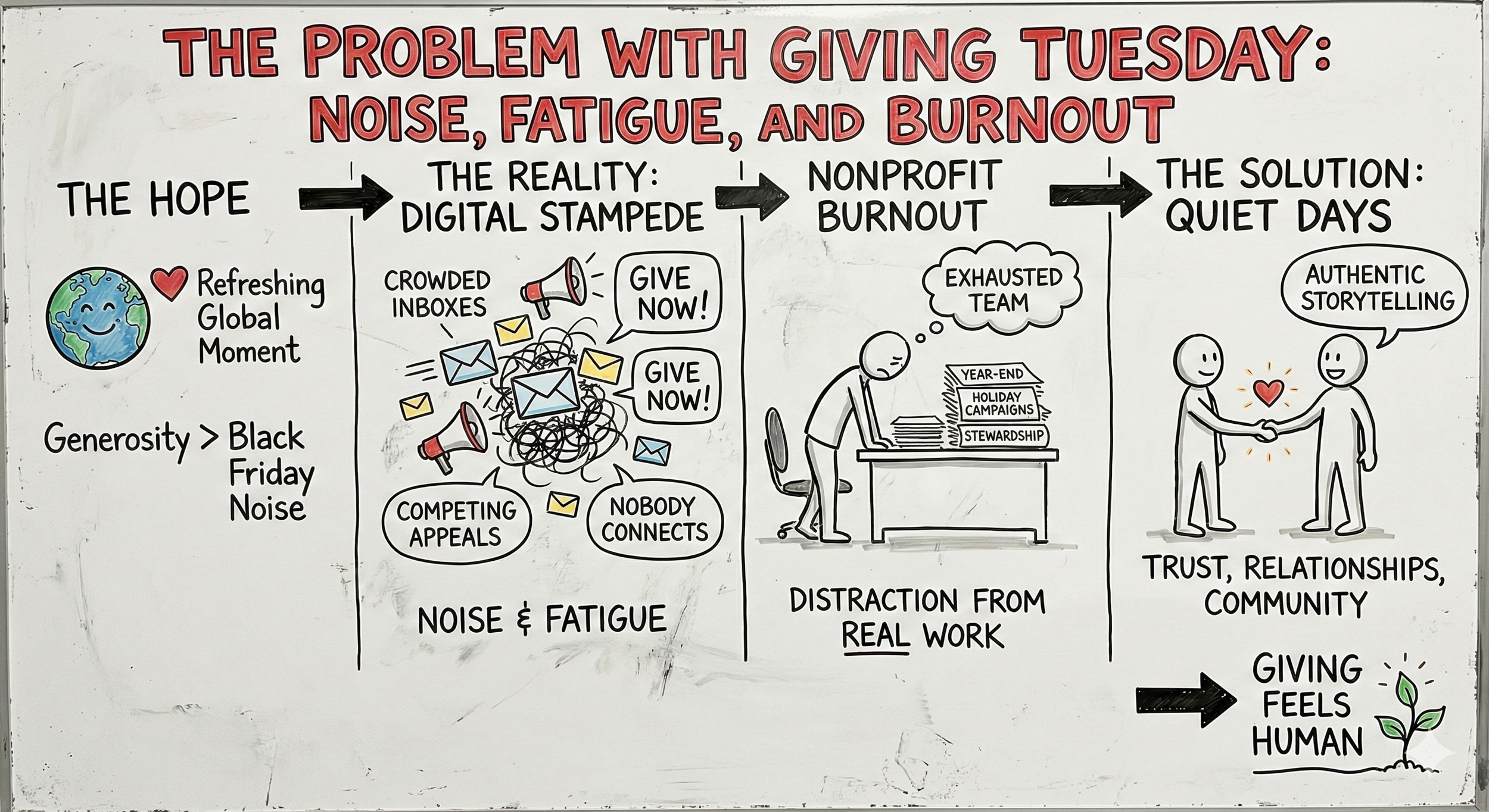
I remember when Giving Tuesday first appeared on the scene. Back then I was at Stupid Cancer, running operations, building digital infrastructure, and trying to hold together a national movement with passion, long nights, and whatever technology we could afford. The idea of Giving Tuesday felt refreshing. A global moment where generosity could rise above the noise of Black Friday and Cyber Monday. It felt like the kind of thing a young nonprofit ecosystem needed.
But even in those early years, something became obvious. The noise did not disappear. It got louder.
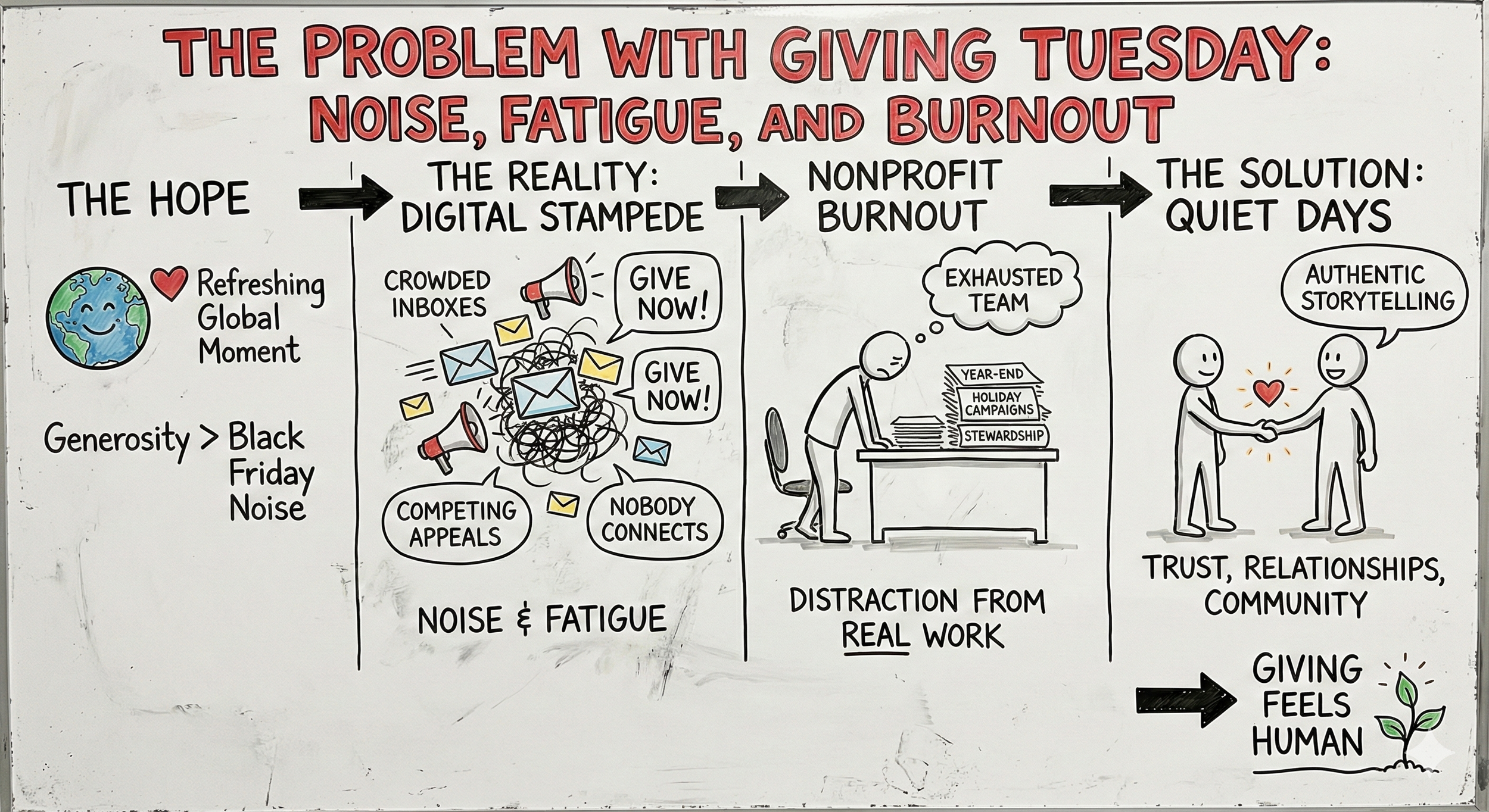
(Image generated from the contents of this blog post using Gemini Nano Banana Pro.)
I remember when Giving Tuesday first appeared on the scene. Back then I was at Stupid Cancer, running operations, building digital infrastructure, and trying to hold together a national movement with passion, long nights, and whatever technology we could afford. The idea of Giving Tuesday felt refreshing. A global moment where generosity could rise above the noise of Black Friday and Cyber Monday. It felt like the kind of thing a young nonprofit ecosystem needed.
But even in those early years, something became obvious. The noise did not disappear. It got louder.
Our Giving Tuesday campaigns at Stupid Cancer never really took off. Not because the mission lacked urgency. Not because the community lacked passion. It was the environment itself. The day quickly became so crowded that inboxes turned into a wall of competing appeals. Every nonprofit, national and local, was sending emails at the exact same moment. We were all telling people that today was the day to give, and the result was that very few messages were actually heard.
Our emails would go out. And then they would vanish into a digital stampede of similar subject lines and similar language, all competing for the same seconds of donor attention. It became clear that when everyone talks at the same time, nobody truly connects. That is the paradox of Giving Tuesday. The energy that was meant to unite the sector created a tidal wave that made it harder for authentic storytelling to land. It trained donors to expect a single day of marketing pressure instead of a year of meaningful engagement.
After 10 years at Testicular Cancer Foundation, I see the same patterns even more clearly. Our strongest support comes from conversations, relationships, and stories that move at the pace of real human connection. The people who support TCF do it because they believe in the urgency of early detection, because they lost someone they loved, because they survived, or because they know a young man who needed help. Those moments do not happen because of a global countdown clock. They happen because of trust.
Giving Tuesday often pulls attention away from that trust. It asks donors to give impulsively, surrounded by competing messages, and that kind of giving rarely translates into long-term commitment. The truth is that the donors who stay with us, the ones who make our work possible, almost never join us because of Giving Tuesday. They join because of a story that reached them at the right moment. They join because someone educates them. They join because they were ready to hear us. None of that has anything to do with a specific Tuesday in late November.
There is another reality too. Larger organizations with major marketing budgets dominate the Giving Tuesday landscape. They have more ads, more staff, more matches, more media. Smaller nonprofits like the ones I have spent most of my career running cannot outshout them. The day amplifies existing inequities. It rewards whoever already has the biggest digital footprint. It becomes a race where the starting line is not the same for everyone.
And for nonprofit teams, especially lean ones, Giving Tuesday is exhausting. It hits right when year-end fundraising is already underway, when staff are working on holiday campaigns, annual reports, donor stewardship, and the final push of the year. The pressure to perform on one prescribed day often distracts from the quieter, more effective work that actually drives mission outcomes.
Looking back, neither Stupid Cancer nor TCF ever saw measurable traction from Giving Tuesday. What we saw were short-lived spikes, small one-time gifts, and a kind of artificial urgency that did not strengthen donor relationships. The long-term supporters, the ones who show up every year, never came from that moment. They came from real conversation, thoughtful timing, and the consistent work of building community.
I still believe in generosity. I believe in the idea behind Giving Tuesday. But I also believe that generosity grows best on quieter days. The days when our message stands alone. The days when supporters hear one story, not fifty. The days when giving feels like connection instead of competition.
Those were the days that mattered at Stupid Cancer. Those are the days that matter now at Testicular Cancer Foundation. And those are the days when generosity feels most human.
When You Feel Like You Don’t Belong at the Table You Built
When I co-founded a nonprofit, I thought the hardest part would be fundraising, or managing volunteers, or learning how to read a budget without breaking into hives. I didn’t expect one of the biggest challenges to be… me.
More specifically, the voice in my head that kept whispering:
“You’re not qualified to be here.”
“They’re going to figure out you don’t know what you’re doing.”
“Any day now, someone will ask you to hand in your keys.”
That voice had a name: imposter syndrome.
And it hit me in moments I didn’t expect—sitting in a meeting with hospital executives, walking into a conference where everyone seemed to have degrees I didn’t, even accepting awards for the work I’d done.
Where it comes from
For accidental founders, imposter syndrome often comes from the gap between how you started and where you are now. I didn’t go to school for nonprofit management. I learned systems by breaking them, fundraising by asking awkwardly, and leadership by getting it wrong before I got it right.
When you build something from scratch, you spend so much time figuring it out on the fly that it can feel like everyone else must have a secret playbook you missed.
What I’ve learned
Credentials aren’t the only currency. Your lived experience, resilience, and ability to rally people around a cause are just as valuable as formal training.
Most people are winging it, too. The folks you’re intimidated by? They’re probably Googling answers under the table.
Your mission matters more than your resume. If you’re showing up for the people you serve, you already belong in the room.
Preparation quiets the voice. The more you document your work, track your impact, and understand your numbers, the less room there is for self-doubt to creep in.
Find your truth-tellers. Surround yourself with people who will remind you of your wins when you can’t see them.
A quiet shift
The turning point for me was realizing that the “real” nonprofit leaders I was comparing myself to… were often comparing themselves to someone else. Everyone feels underqualified when they’re stretching into something bigger.
Now, when I hear that voice, I remind myself: I don’t have to be the most credentialed person in the room. I just have to be the one who cares enough to keep showing up.
If you’ve ever felt like an imposter in your own work, know this: your mission wouldn’t be where it is without you. And if you built the table, you have every right to sit at it.
If this resonates with you, I go deeper into overcoming imposter syndrome—and other challenges accidental founders face—in my book, The Accidental Nonprofiteer. It’s part field guide, part survival manual, and all hard-earned lessons from my years co-founding and growing a national nonprofit.
Your Tech Stack Shouldn’t Require a Decoder Ring
Between 2010 and 2016, when I was building the nonprofit I co-founded, I treated our tech stack like a puzzle only I could solve. If there was a tool with advanced features, hidden settings, and a learning curve steep enough to scare off the average user, I was all in.
Zapier with multi-step filters? Love it.
Custom-coded WordPress plugins? Yes, please.
Google Sheets with so many formulas it looked like mission control? Absolutely.
And here’s the problem: it worked… as long as I was the one running it.
The moment I went on vacation, got sick, or handed something off to a volunteer, the whole system ground to a halt. Not because the mission was complicated—but because I’d made the tools unnecessarily complex.
Over time, I realized this wasn’t just inconvenient—it was risky. If something happened to me, a lot of the organization’s institutional knowledge and access would disappear overnight. That’s not leadership; that’s gambling with the mission.
Here’s what I learned the hard way:
1. Share passwords like the organization depends on it—because it does.
Stop keeping logins in your head or on scraps of paper. Use a shared password manager like 1Password so anyone with the right permissions can access what they need without emailing passwords around. I’ve seen weeks wasted because a critical account was locked and the only person who knew the password was unreachable.
2. Create internal reference documents while you work.
Every time you run a process—publishing a blog post, sending a Mailchimp email, updating the website—write it down in plain language in a shared document. Not polished manuals. Just clear, step-by-step notes. Over time, you’ll build an internal library that makes onboarding easier and keeps operations from grinding to a halt when someone leaves.
3. Favor adoption over optimization.
Squarespace, Mailchimp, Google Drive—these aren’t “basic,” they’re accessible. Your mission isn’t to impress other tech nerds; it’s to keep your systems usable by the widest number of people. The best tool is the one your team can actually use, even if it’s missing a few features you love.
4. Avoid single points of failure.
If you’re the only one who can update the website, send an email blast, or pull a report, you’re not building a sustainable organization—you’re building a bottleneck. The goal is that someone else could run the core operations tomorrow without calling you for help.
5. Think of operations as a risk management tool.
Your tech stack isn’t just about efficiency—it’s about derisking the mission. Staff turnover, illness, vacations, and even emergencies shouldn’t take the organization offline. If your systems are simple, documented, and accessible, the work can continue seamlessly no matter who’s in the chair.
The fancy tools might make you feel like you’re operating on another level. But the real test of your tech stack isn’t how impressive it looks—it’s whether the mission keeps moving when you’re not at the keyboard.

Eleven Years Since Instapeer: Reflecting on What Was—and What’s Still Needed
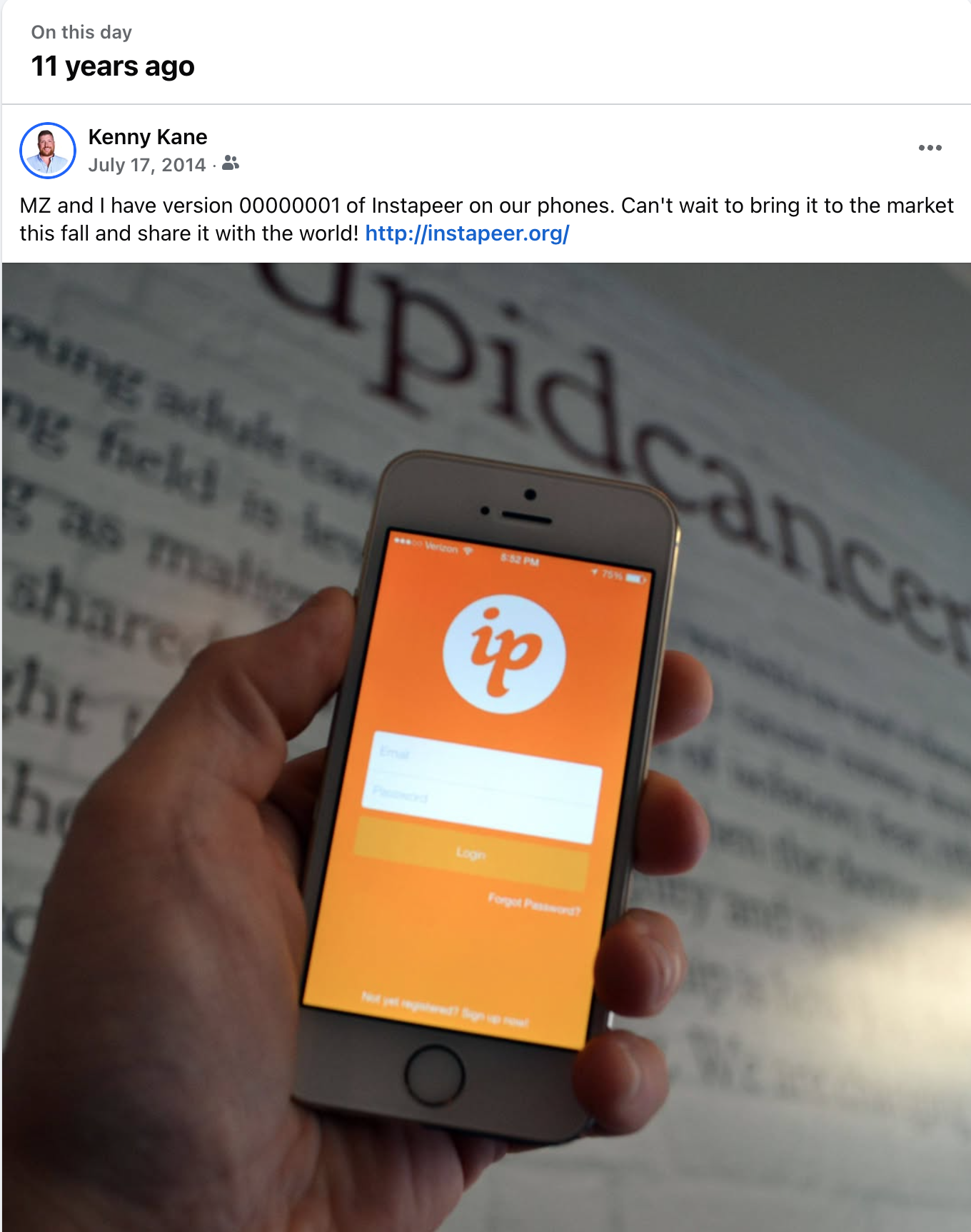
It’s hard to believe it’s been 11 years since Matthew Zachary and I launched Instapeer, a mobile app built for and by young adults affected by cancer. What started as a hopeful experiment in peer connection grew into something that touched thousands of lives—and though the app itself no longer exists, the mission behind it remains as urgent as ever.
Back in 2013, we saw a gap. A huge one. Young people facing cancer often didn’t know anyone their age who understood what they were going through. Support groups skewed older. Social media felt too broad. We believed technology could bridge the loneliness gap—could offer that “me too” moment that changes everything. And for a while, it did.
Instapeer wasn’t perfect, but it was real. People connected. Survivors supported each other. Patients found friends who got it. And we proved that peer-to-peer support doesn’t need a sterile conference room or a monthly meeting—it just needs access and empathy.
But time moves fast, and tech moves faster. We sunset the app a few years later, for reasons that will sound familiar to anyone who's ever built a startup in the nonprofit world: limited funding, shifting priorities, and the natural evolution of platforms and people. Instapeer had its moment, and we were proud of what we built.
Still, as I look around today, the need for what Instapeer represented hasn't gone away. In fact, it may be greater than ever. Mental health is finally getting the attention it deserves in cancer care, but too many young adults are still navigating their diagnosis alone. The isolation is quieter now—spread across fragmented platforms and buried beneath polished Instagram posts. But it's still there.
The future of peer support will look different. It should look different. But it should still exist.
Instapeer may be gone, but its spirit lives on in every DM between survivors, every late-night text to a cancer friend, every small moment where someone feels a little less alone.
There’s still so much work to be done. I hope we keep doing it.
P.S. To everyone who downloaded the app, shared their story, or helped us build Instapeer—you mattered. And you still do.