
The Secret Sauce Behind My Operator Career Is Not an MBA, It Is Zapier
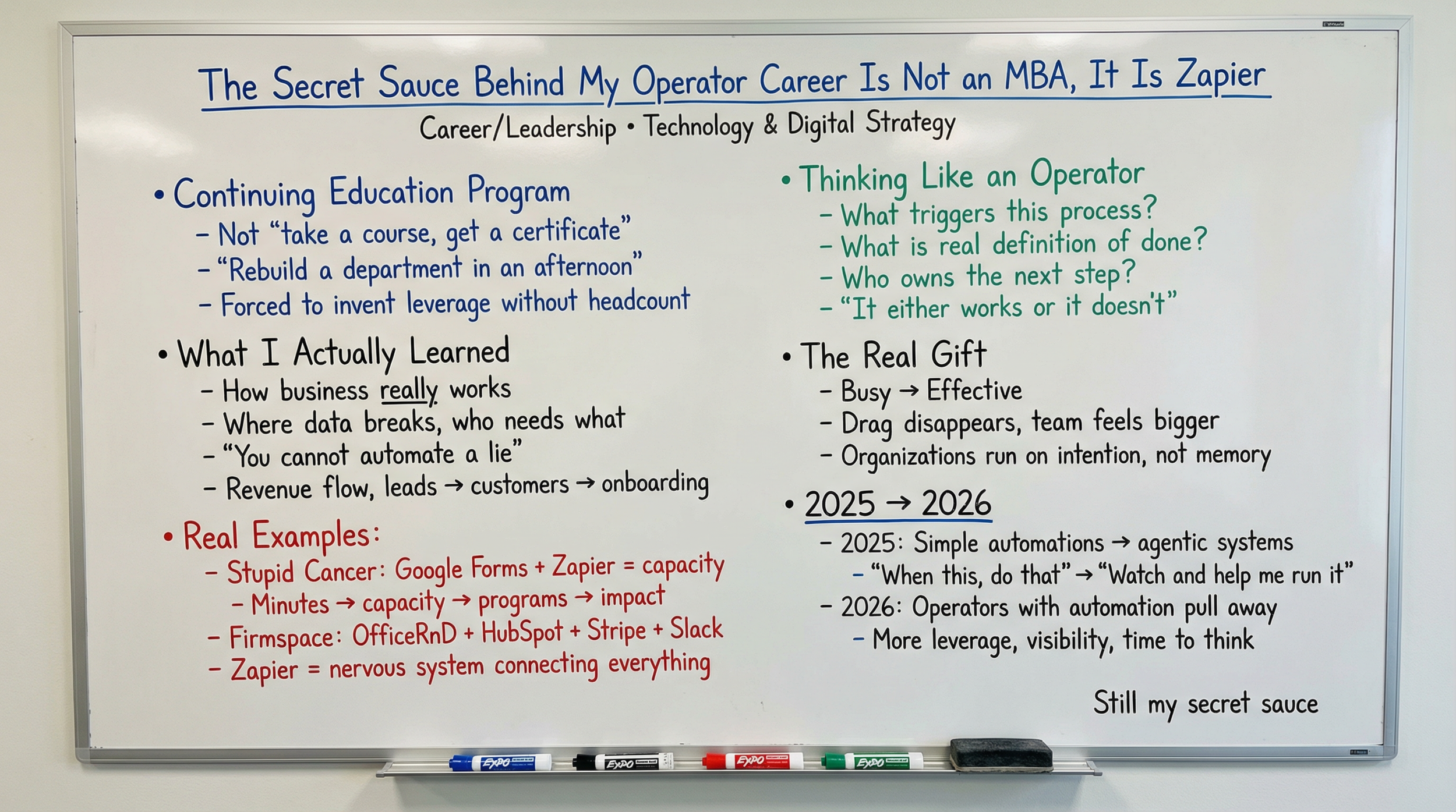
Zapier has quietly been the continuing education program of my operator career.
Not in the “take a course, get a certificate” way. In the “oh wow, I just rebuilt an entire department in an afternoon” way.
I did not come up through some glossy MBA to COO pipeline. I came up through broken spreadsheets, duct-taped CRMs, and nonprofit budgets that forced you to make hard choices fast. When you do not have headcount, you have to invent leverage. Zapier was the first tool that gave me that leverage.
At first it was simple stuff. New donation comes in, add the person to a CRM. New form submitted, send an email. Boring. Necessary. Then something clicked. Every workflow I automated forced me to really understand how the business actually worked. What was the source of truth. Where data broke. Who needed to know what and when. Automation has a way of exposing reality. You cannot automate a lie.
That is where the continuing education part came in.
Every time I built a Zap, I was really learning operations. I was learning how revenue moved. How leads became customers. How support tickets became churn. How marketing actually flowed into sales and how sales flowed into onboarding. Zapier became my lab. Instead of reading case studies about how companies scale, I was building tiny versions of those systems myself.
When I was running Stupid Cancer, we did not have a big development team. We had passion, Google Forms, and Zapier. Donations flowed into Mailchimp. Event signups flowed into spreadsheets that became volunteer lists. Every automation shaved minutes off someone’s day. Those minutes added up to real capacity. Real capacity turned into programs. Programs turned into impact. That was not a theoretical MBA lesson. That was Tuesday.
Later, when I moved deeper into tech and then into real estate with Firmspace, the same pattern repeated. We had OfficeRnD, HubSpot, Stripe, Slack, Notion, and a dozen other systems that all thought they were the center of the universe. Zapier was the nervous system that made them behave like one company instead of a pile of apps. Leads from the website became deals. Deals became signed agreements. Agreements became onboarding tasks. Onboarding became access control and billing. That entire chain exists today because of hundreds of tiny decisions encoded into automations.
Here is the part most people miss. Zapier did not just save time. It taught me how to think like an operator.
When you automate something, you have to answer brutal questions. What actually triggers this process. What is the real definition of done. What happens when it breaks. Who owns the next step. You cannot hide behind vibes when a Zap is running. It either works or it does not. Over time, that discipline leaks into everything else you do. You start designing org charts, roles, and even strategies with the same clarity.
It is also why I say Zapier is the secret sauce of my career.
I have walked into nonprofits, startups, and real estate businesses that were “busy” but not effective. People were copying and pasting. Forwarding emails. Manually reconciling lists. You can feel the drag in a system like that. The moment you introduce automation, the drag disappears and suddenly the same team feels like a much bigger one. That is not magic. That is leverage.
In the last few years, that leverage has gone exponential. Zapier is no longer just moving data. It is now orchestrating AI, bots, and agents. At Testicular Cancer Foundation we are wiring donor journeys, survivor intake, content publishing, and community workflows through the same automation backbone. At Firmspace we are using it to connect marketing, sales, operations, and member experience into one continuous system. The tools changed. The mindset did not.
I still think of Zapier as my ongoing degree in operations.
Every new app I connect teaches me something about how that part of the business really works. Every broken Zap forces me to debug not just the workflow but the underlying process. Every new automation is a small investment in future me having less chaos and more clarity.
That is the real gift. It is not about being clever with software. It is about building organizations that run on intention instead of memory.
2025 took us from simple automations to truly agentic systems. We went from “when this happens, do that” to “watch this process and help me run it.” That shift is huge. 2026 is where operators who understand automation will start pulling away. Not because they are smarter, but because they have more leverage, more visibility, and more time to think.
Zapier is still my secret sauce. It just happens to be a lot more powerful now.
