The Problem With Giving Tuesday: Noise, Fatigue, And Burnout

I remember when Giving Tuesday first appeared on the scene. Back then I was at Stupid Cancer, running operations, building digital infrastructure, and trying to hold together a national movement with passion, long nights, and whatever technology we could afford. The idea of Giving Tuesday felt refreshing. A global moment where generosity could rise above the noise of Black Friday and Cyber Monday. It felt like the kind of thing a young nonprofit ecosystem needed.

But even in those early years, something became obvious. The noise did not disappear. It got louder.

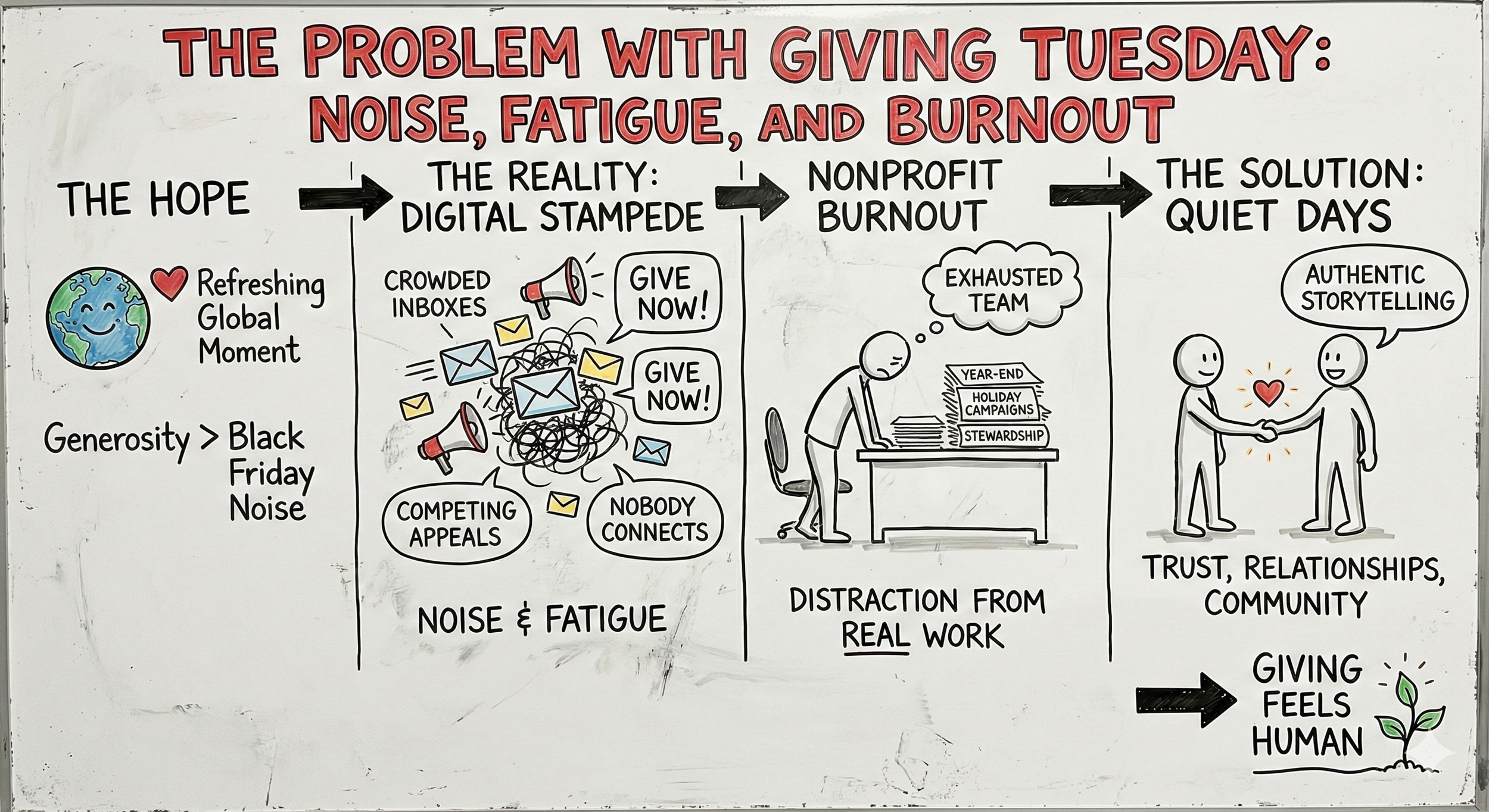
(Image generated from the contents of this blog post using Gemini Nano Banana Pro.)

I remember when Giving Tuesday first appeared on the scene. Back then I was at Stupid Cancer, running operations, building digital infrastructure, and trying to hold together a national movement with passion, long nights, and whatever technology we could afford. The idea of Giving Tuesday felt refreshing. A global moment where generosity could rise above the noise of Black Friday and Cyber Monday. It felt like the kind of thing a young nonprofit ecosystem needed.

But even in those early years, something became obvious. The noise did not disappear. It got louder.

Our Giving Tuesday campaigns at Stupid Cancer never really took off. Not because the mission lacked urgency. Not because the community lacked passion. It was the environment itself. The day quickly became so crowded that inboxes turned into a wall of competing appeals. Every nonprofit, national and local, was sending emails at the exact same moment. We were all telling people that today was the day to give, and the result was that very few messages were actually heard.

Our emails would go out. And then they would vanish into a digital stampede of similar subject lines and similar language, all competing for the same seconds of donor attention. It became clear that when everyone talks at the same time, nobody truly connects. That is the paradox of Giving Tuesday. The energy that was meant to unite the sector created a tidal wave that made it harder for authentic storytelling to land. It trained donors to expect a single day of marketing pressure instead of a year of meaningful engagement.

After 10 years at Testicular Cancer Foundation, I see the same patterns even more clearly. Our strongest support comes from conversations, relationships, and stories that move at the pace of real human connection. The people who support TCF do it because they believe in the urgency of early detection, because they lost someone they loved, because they survived, or because they know a young man who needed help. Those moments do not happen because of a global countdown clock. They happen because of trust.

Giving Tuesday often pulls attention away from that trust. It asks donors to give impulsively, surrounded by competing messages, and that kind of giving rarely translates into long-term commitment. The truth is that the donors who stay with us, the ones who make our work possible, almost never join us because of Giving Tuesday. They join because of a story that reached them at the right moment. They join because someone educates them. They join because they were ready to hear us. None of that has anything to do with a specific Tuesday in late November.

There is another reality too. Larger organizations with major marketing budgets dominate the Giving Tuesday landscape. They have more ads, more staff, more matches, more media. Smaller nonprofits like the ones I have spent most of my career running cannot outshout them. The day amplifies existing inequities. It rewards whoever already has the biggest digital footprint. It becomes a race where the starting line is not the same for everyone.

And for nonprofit teams, especially lean ones, Giving Tuesday is exhausting. It hits right when year-end fundraising is already underway, when staff are working on holiday campaigns, annual reports, donor stewardship, and the final push of the year. The pressure to perform on one prescribed day often distracts from the quieter, more effective work that actually drives mission outcomes.

Looking back, neither Stupid Cancer nor TCF ever saw measurable traction from Giving Tuesday. What we saw were short-lived spikes, small one-time gifts, and a kind of artificial urgency that did not strengthen donor relationships. The long-term supporters, the ones who show up every year, never came from that moment. They came from real conversation, thoughtful timing, and the consistent work of building community.

I still believe in generosity. I believe in the idea behind Giving Tuesday. But I also believe that generosity grows best on quieter days. The days when our message stands alone. The days when supporters hear one story, not fifty. The days when giving feels like connection instead of competition.

Those were the days that mattered at Stupid Cancer. Those are the days that matter now at Testicular Cancer Foundation. And those are the days when generosity feels most human.

Read More