
Kenny’s 2026 Tech Stack
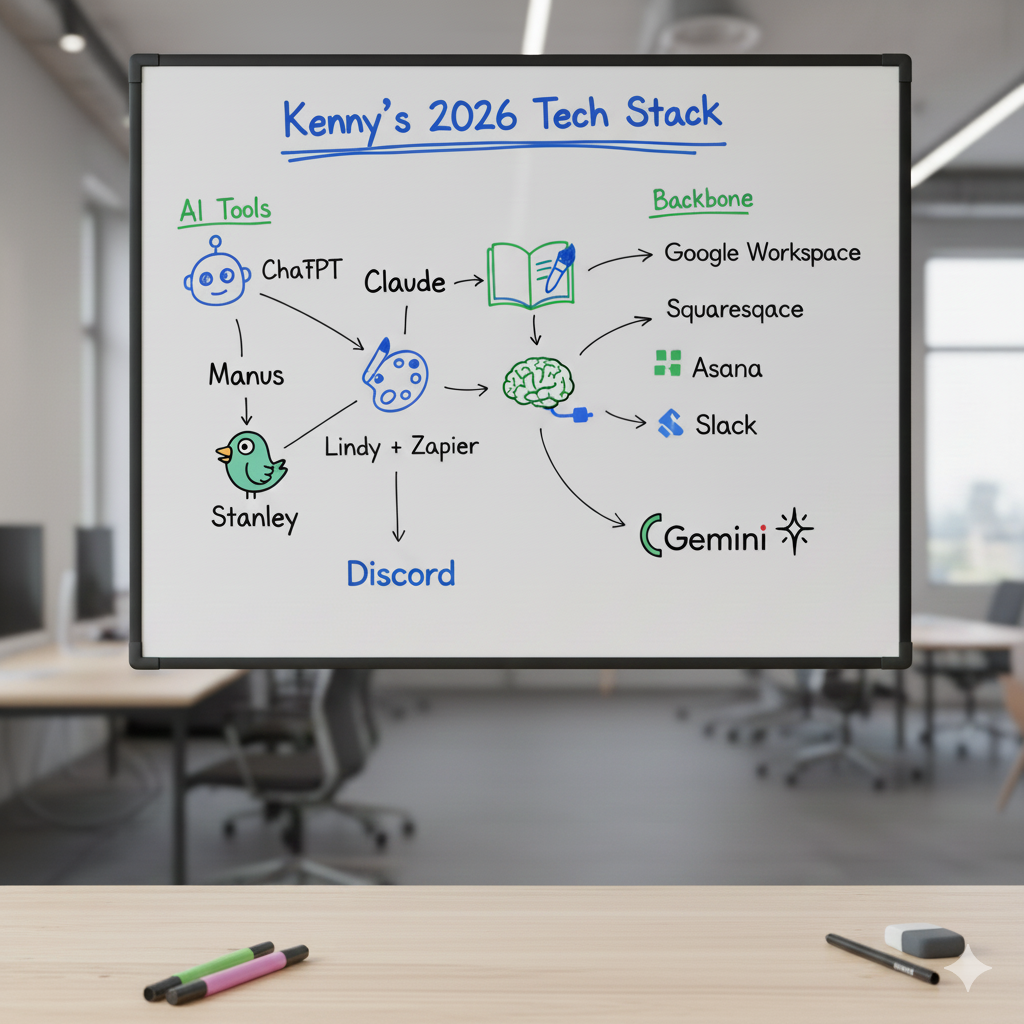
Courtesy of Nano Banana.
People often ask what tools I rely on day to day. The honest answer is that my stack is less about novelty and more about reliability. I care far more about whether something fits into my operating rhythm than whether it is the newest thing on Product Hunt.
This is a snapshot of the tools I’m using right now, how they show up in my work, and where I’m seeing real value versus diminishing returns.
ChatGPT: My Daily Operating Layer
I use ChatGPT for everyday tasks more than any other tool. This is my thinking partner, drafting assistant, problem-solver, and first stop for almost everything.
It helps me clarify ideas, pressure-test decisions, draft writing, and think through systems rather than just outputs.
Granola for Meetings
One newer addition to my workflow is Granola for transcription. I use it to capture conversations, working sessions, and ad-hoc thinking that would otherwise disappear. The real value isn’t just the transcript itself, but the ability to turn spoken ideas into searchable, referenceable material I can return to later. It’s especially useful for preserving nuance, intent, and context that doesn’t always make it into notes or task managers. Like the best tools in my stack, it works quietly in the background and reduces the friction between thinking, talking, and writing.
Claude: Long-Form Thinking, Writing, and Code
I rely heavily on Claude for long-form writing, book drafts, and extended thinking that requires sustained coherence. It’s also my go-to for large-context editing and code support.
When something spans dozens or hundreds of pages, Claude is usually where that work lives.
Manus: Design and Build Support
I use Manus alongside Claude for website design and coding experiments. It’s useful when I want momentum and exploration without over-committing too early.
Lindy + Zapier: Agents, Not Just Automations
For agent-style workflows, I use Lindy and Zapier.
Zapier remains the connective tissue that makes things reliable, while Lindy is where I experiment with delegation-style automation rather than simple triggers.
Stanley: LinkedIn Experiments (With Limits)
I’ve experimented with Stanley for LinkedIn content. Early value was strong for idea generation and format testing, but returns are diminishing. Voice and judgment matter more than volume at this stage.
Gemini: Image Generation and More
I use Gemini primarily for image generation, and increasingly for other tasks as Google continues to integrate it more deeply across their ecosystem.
The Backbone: Tools That Just Work
Some tools don’t get much attention because they’re stable and predictable, which is exactly why they matter:
These tools don’t change often, and that’s part of their value.
Discord: Growing, But Not Core (Yet)
My Discord usage increased this year, mostly for community-driven conversations and experimentation. It’s not a primary platform for me yet, but it’s no longer fringe either.
Final Thought
My stack isn’t about chasing tools. It’s about reducing friction between thinking and execution. AI tools now sit at the center of that equation, but only because they integrate cleanly with systems I already trust.
The best stack isn’t the one with the most tools. It’s the one that quietly gets out of your way.
