
A Few Notes From 2025
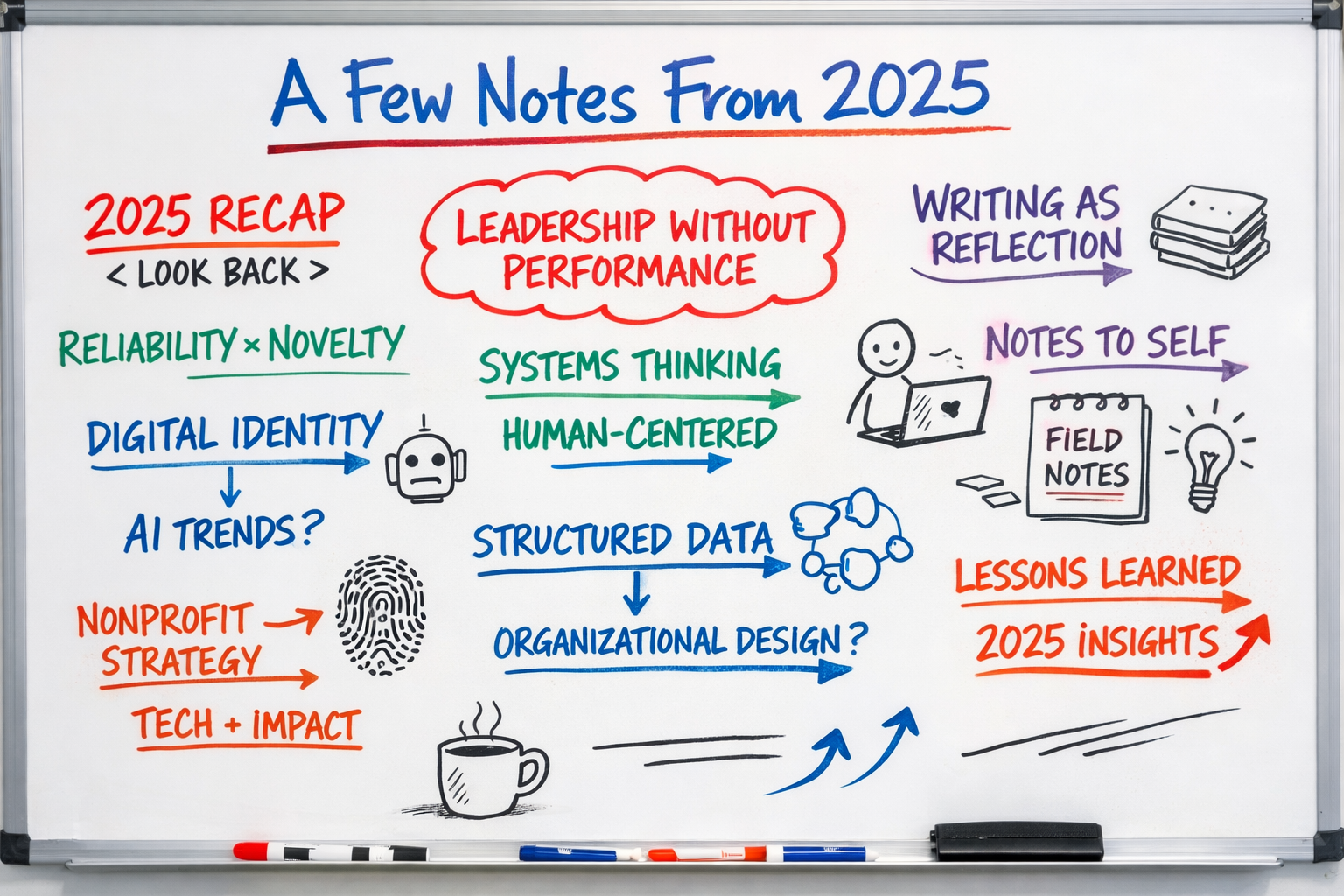
I didn’t really plan to write a year in review.
This is more me noticing a few patterns that kept showing up.
Most of the things I worked on this year, across writing, nonprofits, real estate, and tech, kept circling the same questions:
What actually holds up over time?
What quietly breaks?
What needs a human, and what really just needs a system?
That framing ended up shaping more of my thinking than any single project.
Less Flash, More Reliability
I’ve grown a little allergic to shiny things.
Not because new ideas aren’t interesting, but because I’ve seen how often they fall apart under real use. I care a lot more now about whether something works consistently than whether it demos well.
That shows up in how I think about AI, tools, and tech stacks. I don’t want clever. I want boring and dependable. The best tools fade into the background once they’re set up right.
A lot of what I wrote this year, about AI, structure, systems, and even workspace design, was really about that.
Leadership That Doesn’t Need a Stage
I also spent time thinking about leadership without the performance layer.
The kind that shows up in handoffs, documentation, and decisions you make knowing you won’t be around forever. The stuff no one applauds but everyone depends on.
I don’t have much interest in leadership that only works when the leader is in the room. If things fall apart the second someone steps away, that’s not leadership. That’s dependency.
That idea kept sneaking into posts about trust, support, and why I prefer field notes over keynotes.
Nonprofits and the Cost of Constant Urgency
Some of my heavier thinking this year landed around nonprofits.
Urgency gets rewarded. Calm systems don’t. But urgency burns people out, confuses priorities, and hides structural problems. I wrote about Giving Tuesday and donor platforms not because they’re bad, but because they sometimes distract from building things that last.
I keep coming back to this. Most nonprofit problems aren’t passion problems. They’re systems problems.
And no amount of energy fixes a structure that isn’t designed to hold.
Digital Identity Is a Thing Now
One thing I didn’t expect to think about as much as I did was digital identity.
Not branding. Accuracy.
Machines are already telling stories about us. If you don’t participate, they’ll just fill in the gaps. That realization changed how I think about things like structured data, search results, and public narratives.
It’s not about ego. It’s about not letting your work get flattened or misrepresented by default systems.
Writing as a Way to Keep Track
This year, writing felt less like content and more like leaving notes for myself.
What did I learn?
Why did this decision make sense at the time?
What would I forget if I didn’t write it down?
Some posts were personal. Some were technical. Some were me trying to name something I couldn’t quite articulate yet. All of them were attempts to slow things down long enough to understand them.
A Few Things That Feel True Right Now
I don’t know what 2026 brings, but a few things feel settled:
Reliability beats novelty.
Documentation is underrated.
AI works best when it’s quiet.
Leadership is what survives transitions.
Good systems make it easier to be human.
Nothing flashy. Just notes I don’t want to lose.
That’s probably enough for now.
If You Want to Read a Bit More
If you’re curious where people tend to land first, these are a few of the posts from this year that get the most traction:
