
How I Wrote a 35,000-Word Book in Three Days Using Claude as My Writing Partner
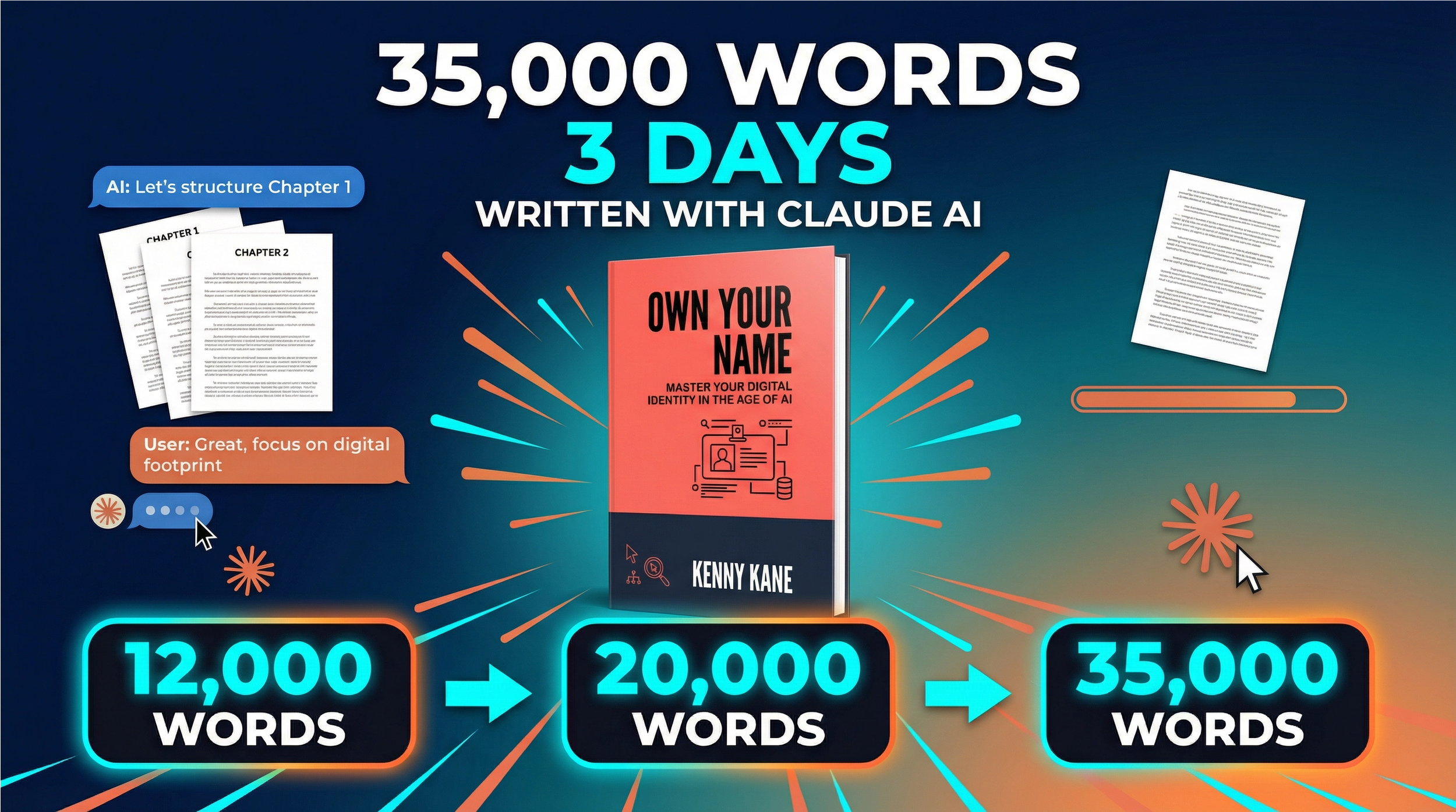
I just finished the manuscript for my third book, Own Your Name: A Practical Guide to Digital Disambiguation in the Age of AI.
Thirteen chapters.
A prologue and conclusion.
Five appendices.
A dedication, author’s note, and acknowledgments.
Roughly 35,000 words.
It took three days.
Not three days of planning followed by months of writing. Three days from the first drafted chapter to a compiled, Kindle-ready manuscript. And the process matters as much as the book itself.
The Setup: Years of Living, Days of Writing
Let me be clear upfront: the writing took three days.
The thinking took twenty years.
The timing wasn’t accidental. Anthropic had just released Claude Opus 4.6, and I wanted to test it on something real. Not a demo. Not a clever prompt. A full book manuscript built from two decades of lived experience.
This book documents my twenty-year effort to control my digital identity after losing KennyKane.com at seventeen. It covers structured data, Wikidata, Google Knowledge Panels, AI citation, blogging strategy, and the mechanics of building a digital ecosystem that makes you discoverable by both humans and machines.
I didn’t invent that in a weekend. I lived it.
What I didn’t have was a manuscript.
That’s where Claude came in.
Day One: Thursday, February 6
The first session began Thursday evening. I sat down with Claude and explained the arc of the story. The journey. The lessons. The structure I thought the book needed.
We drafted the Prologue and Chapters 1 through 5 in a single session.
The process was conversational. I described what happened and what it meant. Claude asked clarifying questions that forced precision. Then a chapter emerged from the exchange.
The Prologue—the story of letting KennyKane.com expire for fifteen dollars—came out almost fully formed. I had told that story for years. Writing it down was simply capture, not invention.
By the end of the night, we had roughly 12,000 words.
Day Two: Friday, February 7
Friday had two sessions.
Morning:
We revised Chapters 1 through 6, tightened language, corrected timelines, and ensured cross-chapter consistency. Chapter 6, focused on publishing as authority building, was drafted.
Evening:
Momentum accelerated. Chapters 7 and 8 came together—blogging strategy and AI citation.
Chapter 8 became the emotional center of the second half: asking ChatGPT who founded Stupid Cancer and discovering my name wasn’t in the answer.
That chapter required proof, not storytelling.
I brought real data:
Semrush AI visibility trends
Google Search Console growth
Fathom Analytics traffic
The numbers told the story more convincingly than I ever could.
By the end of Friday, we had crossed 20,000 words.
Day Three: Saturday, February 8
Saturday was the marathon.
We drafted Chapters 9 through 13, the conclusion, dedication, appendices, acknowledgments, and author’s note. Then we performed a full manuscript revision—fact-checking claims, aligning cross-references, and correcting narrative simplifications.
Several fixes only I could make.
Nuance matters when the story is yours.
I also brought final validation data:
Google Search Console: 7 clicks in October 2024 → 720 clicks in January 2026
Fathom Analytics: 11,400 unique visitors and 24,700 views in a year, with clear acceleration after structured data implementation
We finalized the title, compiled 23 working files into a single manuscript, and formatted everything for Kindle Create at 5.5 × 8.5 inches.
Thirty-five thousand words.
Three days.
One complete book.
How Conversation Becomes a Book
People assume AI writing means typing a prompt and receiving chapters.
That isn’t what happened.
The real workflow looked like this:
I talked.
Claude asked questions.
I explained events, decisions, and lessons.
Claude forced specificity.
Structure emerged from dialogue.
Drafts followed understanding.
Then I corrected what was wrong.
This step is critical.
AI accelerates writing.
It does not replace judgment.
I wrote about this directly in the book’s Author’s Note:
I wrote my books with AI’s help, not by AI.
Claude made the process faster and more organized, but it didn’t replace the thinking, the research, or the experience behind the words.
The three-day timeline is real.
But it only exists because the twenty years before it were real.
The Numbers
For anyone curious about raw output:
Session 1 (Thursday): Prologue + Chapters 1–5 → ~12,000 words
Session 2 (Friday morning): Revisions + Chapter 6 → ~3,000 new words
Session 3 (Friday evening): Chapters 7–8 → ~5,500 words
Session 4 (Saturday): Chapters 9–13, conclusion, appendices, full revision → ~14,500 words
Total: ~35,000 words across 23 sections
Final deliverable: Single formatted .docx ready for Kindle Create
What Happened Next
The same day the manuscript was compiled, I designed a cover, formatted the interior, wrote the Amazon description, and submitted the book to KDP.
Three days from first draft to “In Review.”
I also asked ChatGPT and Manus to critique the manuscript.
Both produced thoughtful feedback.
Both made factual errors.
The most important corrections still came from rereading my own work.
Because in the end, authorship is responsibility, not speed.
The System Behind the Book
This book is about building digital ecosystems that reinforce identity.
So the book itself becomes part of that ecosystem:
New schema markup on kenny-kane.com
New Wikidata references
New citations, listings, and structured signals
And this post, documenting the process in the open
The system the book describes is the system that publishes the book.
That’s the point.
If you’ve ever searched your own name and felt invisible, this work was written for you.
Written with Claude.
Lived by Kenny Kane.
