
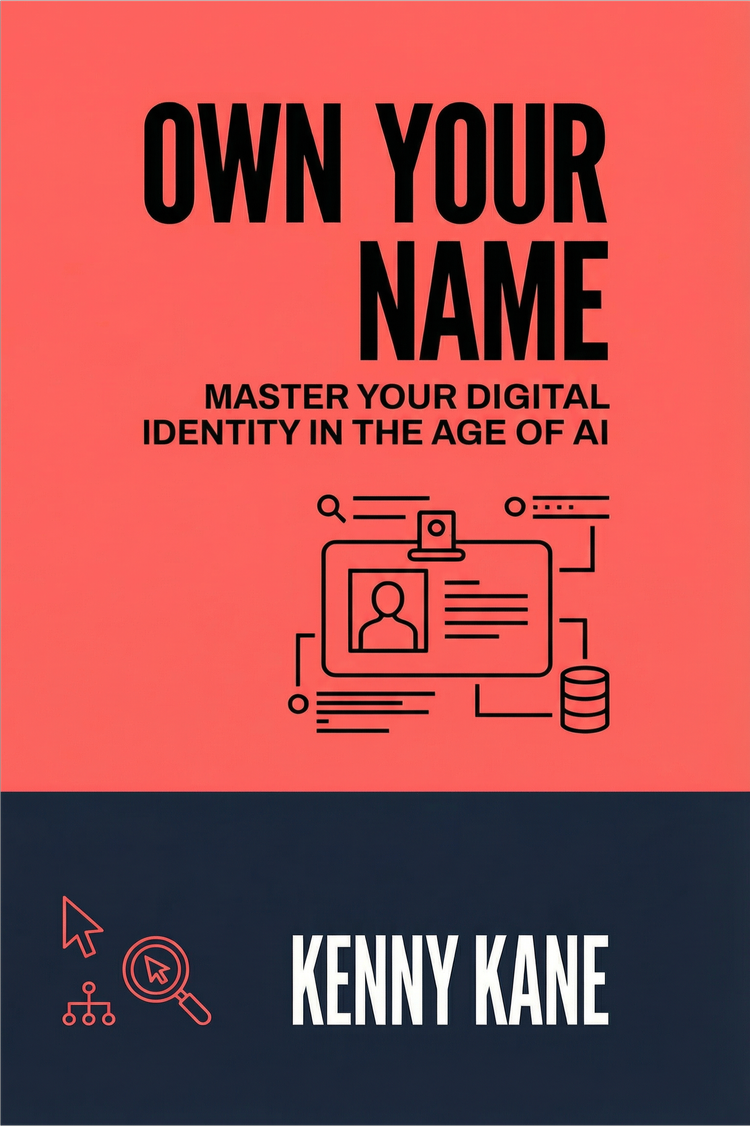
Own Your Name
A Practical Guide to Digital Disambiguation in the Age of AI
I lost KennyKane.com at seventeen and spent twenty years sharing search results with a comedian, a rapper, and a fictional character. This book documents the methods I used to make the public record about me accurate and machine-readable: structured data, Wikidata, verified profiles, consistent naming, and the maintenance that keeps them aligned.
It is a technical manual for a records problem, not a guide to building a personal brand.
Why This Book Exists
Search engines and AI systems assemble a person from whatever exists.
If the available signals are absent, thin, or contradictory, the systems guess. The guess then propagates: into search results, into answer engines, into the profile someone reads before a meeting. Nobody is doing this on purpose. It is what happens when a record has gaps in it.
My own record had gaps for two decades. Fixing it turned out to be an infrastructure problem with a fairly ordinary solution: publish accurate structured data, maintain a sourced entity, keep names and affiliations consistent across the places that already exist, and give the systems something unambiguous to point at.
This book documents that work. It assumes no agency, no engineering background, and no budget beyond time.
What is written down determines what survives when nobody is there to explain it.
What's Inside
Six parts, in the order I actually did them.
-
Structured data and schema
What machine-readable markup does, and how to state who you are — and who you are not — in a form search engines parse rather than infer.
-
The Wikidata method
How to create and source a Wikidata entity, what counts as an acceptable reference, and what has to be true before a Knowledge Panel appears.
-
Generative engine optimization
How AI systems select and attribute sources, and what makes a record citable rather than merely present.
-
The digital ecosystem
Building a hub-and-spoke structure in which a site, third-party profiles, and published work reference each other consistently instead of drifting apart.
-
Writing as infrastructure
Publishing that serves readers and stays parseable, and why consistency over years matters more than volume in any given month.
-
Measuring what works
Which signals indicate the record is being read correctly, which ones move for unrelated reasons, and how long changes take to register.
Who It's For
People whose public record is wrong or fragmented.
This is a narrow problem with a specific set of readers. If none of the following describes you, the book will not be much use.
- People who share a name with someone more prominent, or with several someones
- Authors, consultants, and executives whose work is attributed inconsistently across sources
- Anyone maintaining an organizational record alongside a personal one
- Anyone who needs a public record to be accurate because other people make decisions from it
Where It Sits
The third of three.
Each of my books describes the same failure from a different angle: capability, or knowledge, or identity ends up living somewhere fragile, and holds only as long as someone is there to explain it. The first two are about organizations. This one applies the problem to a person.
In August 2026 I began doctoral study at Texas State University's McCoy College of Business. My research interests are in organizational durability and executive dependency: why execution capacity concentrates in individuals, and what documentation, process design, and technology actually transfer when those individuals leave. These books are the practitioner record that came first.
About the Author
Kenny Kane runs organizations and studies what makes them durable.
He is CEO of Firmspace, a premium private office and executive suite company with locations in Austin, Denver, Houston, and Atlanta; CEO of the Testicular Cancer Foundation; and Co-Founder, Board Member, and Chief Technology Officer of Gryt Health.
He has spent more than fifteen years in operating roles across real estate, health technology, and the nonprofit sector, including six years at Stupid Cancer, where he joined as an intern in 2010 and left as Chief Operating Officer in 2016. He is a doctoral student at Texas State University's McCoy College of Business and lives in Austin, Texas.

Details
Editions and listings.
- PublishedFebruary 9, 2026
- Length191 pages
- FormatsPaperback, Kindle, Apple Books, Google Play
- IdentifiersASIN B0GMDD7CWK (Kindle) · ASIN B0GWK3KKB4 (paperback)
- Reviews
- Also listedForbes Councils Executive LibraryA member listing in Forbes Councils, a paid membership program. Not Forbes editorial coverage.
- Author pages
- Verify
Review copies and excerpts.
For a review copy, permission to republish an excerpt, or a conversation about the material, get in touch.