Listening to Your Emails and Messages Makes You a Better Communicator
For most of my career, I’ve moved fast. I’ve relied on instinct, momentum, and the ability to figure things out on the fly. In small teams or early-stage environments, that approach works. You don’t have to explain every step or provide perfect clarity—you just build, adjust, and keep going. But as the organizations around me grew, the cost of unclear communication started to show up in ways I couldn’t ignore. I’d send a message that made perfect sense in my head, only to realize later it didn’t land the way I intended. Or I’d fire something off quickly and it would accidentally create more work or confusion for someone else. That’s when I started using a small Mac feature that unexpectedly became one of the most effective productivity habits I’ve ever built: Speak Selection.
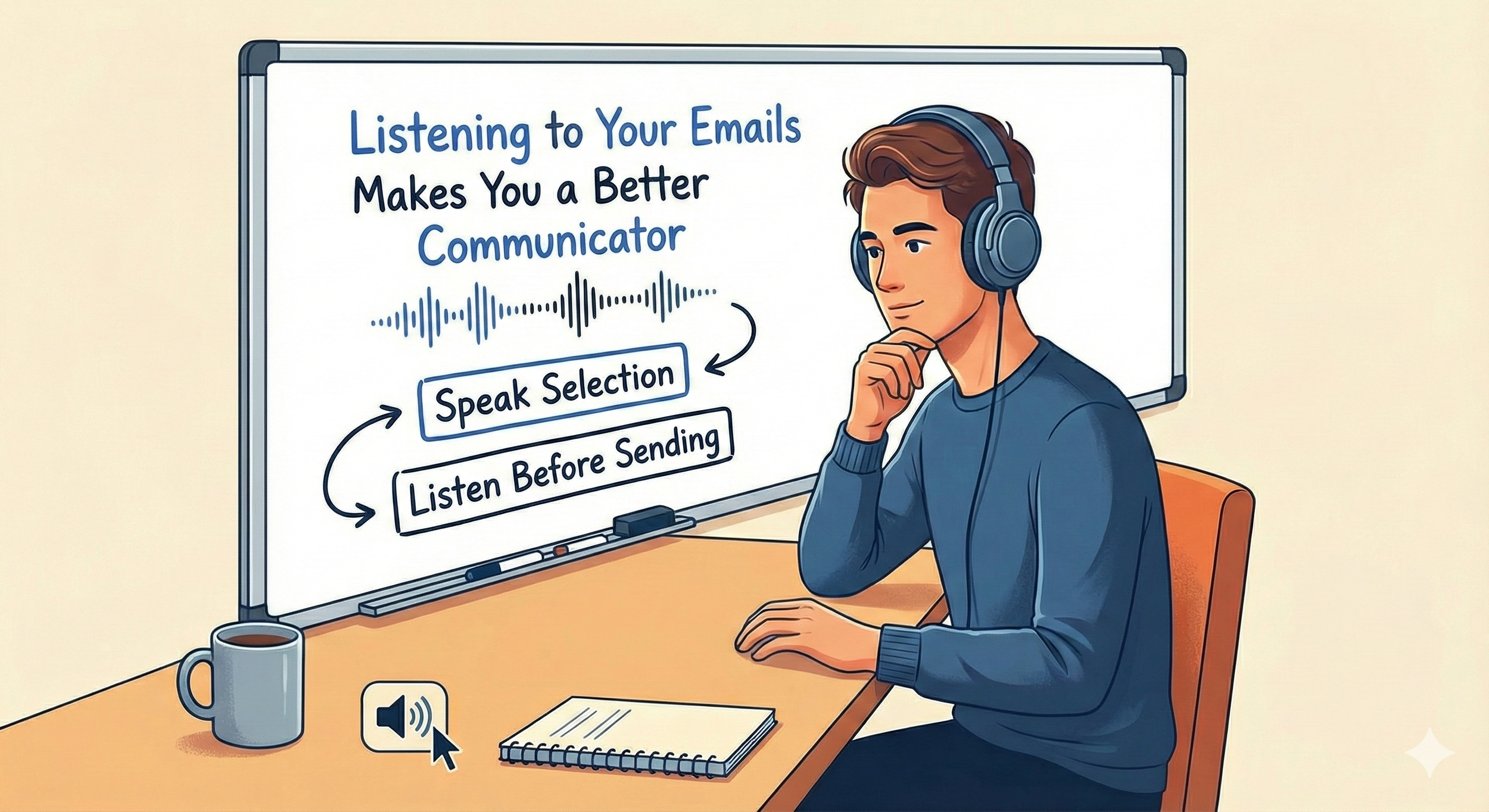
(Image generated from the contents of this blog post using Gemini Nano Banana Pro.)
For most of my career, I’ve moved fast. I’ve relied on instinct, momentum, and the ability to figure things out on the fly. In small teams or early-stage environments, that approach works. You don’t have to explain every step or provide perfect clarity—you just build, adjust, and keep going. But as the organizations around me grew, the cost of unclear communication started to show up in ways I couldn’t ignore. I’d send a message that made perfect sense in my head, only to realize later it didn’t land the way I intended. Or I’d fire something off quickly and it would accidentally create more work or confusion for someone else. That’s when I started using a small Mac feature that unexpectedly became one of the most effective productivity habits I’ve ever built: Speak Selection.
On my computer, I’ve set it to Option + Escape. I highlight the text, hit the keys, and my Mac reads it back to me. I originally used it for dense or long-form content I wanted to listen to instead of read. But when I tried it on a message I was about to send—just out of curiosity—it completely changed how I communicate. Hearing your own words out loud forces you to experience them the way someone else will. It reveals the places where you ramble, where you assume too much context, where your tone is sharper than you meant, or where you simply aren’t as clear as you think. Something that feels tight and logical in your head can sound scattered when read aloud by a voice that isn’t carrying all your internal shorthand.
Listening before I send has made me write with more empathy and precision. It’s a ten-second pause that keeps me from creating accidental work or friction for someone else. It turns vague ideas into cleaner sentences. It catches tone issues that I would never see by reading silently. And it helps me slow down long enough to think, “If I were receiving this, would I know exactly what the sender means?” That small moment is all it takes to turn communication from a reflex into an operational discipline. It’s not about perfection—just alignment. Speak Selection has become one of the simplest and most unexpectedly powerful tools in my workflow. And if you’ve ever felt like your communication doesn’t always match your intent, this tiny shortcut might be the easiest habit to adopt.