
The Age of Gatekept Information Is Over (AI Agents Are Ending It)
For most of modern history, information has been treated like privilege.
Sometimes that was intentional. Sometimes it was just the natural outcome of how systems evolved. But the effect was the same: if you did not know where to look, who to ask, or how to interpret what you found, you stayed stuck.
Gatekeeping was not always malicious. But it was real.
It showed up in healthcare, finance, education, legal services, entrepreneurship, and leadership. And in the nonprofit world, it often showed up in the cruelest form: the people who needed information most were the least likely to access it quickly, clearly, and without friction.
That era is ending.
Not because information suddenly became more available. We have had access for years.
It is ending because AI agents are making information usable.
The real problem was never lack of information
The internet gave us an infinite library. It did not give us a guide.
Search solved access, but it did not solve navigation. It created a new form of inequality: information abundance without interpretation.
People did not need more content. They needed the right answer in plain language at the moment of need, without judgment, and without having to wait.
That is where AI agents are different. They are not just retrieval. They are translation.
We are moving from search to support
Search assumes something most people do not have in moments of crisis: calm.
Search also assumes you know how to ask the right question. But the hardest part is often knowing what to ask.
That works fine when you are looking up restaurant hours or comparing flight prices. It does not work when you are trying to understand symptoms, side effects, or what your next step should be after hearing a diagnosis you never expected.
In those moments, people do not need ten links. They need a guide.
AI agents are that guide.
The bottleneck was always availability
In the old world, help required someone with knowledge to be available. That is what made information scarce.
Availability became the bottleneck.
AI changes that by separating knowledge from availability. That is the real disruption.
It is not that the answers are faster. It is that support becomes accessible without dependency. That matters because dependency is expensive in time, money, staffing, and emotional bandwidth.
If you run a mission-driven organization, you already know the math. Even the best team hits limits. Need always exceeds capacity.
AI agents reduce that pressure without pretending to replace humans.
Why I put a Chatbase agent on TesticularCancer.org
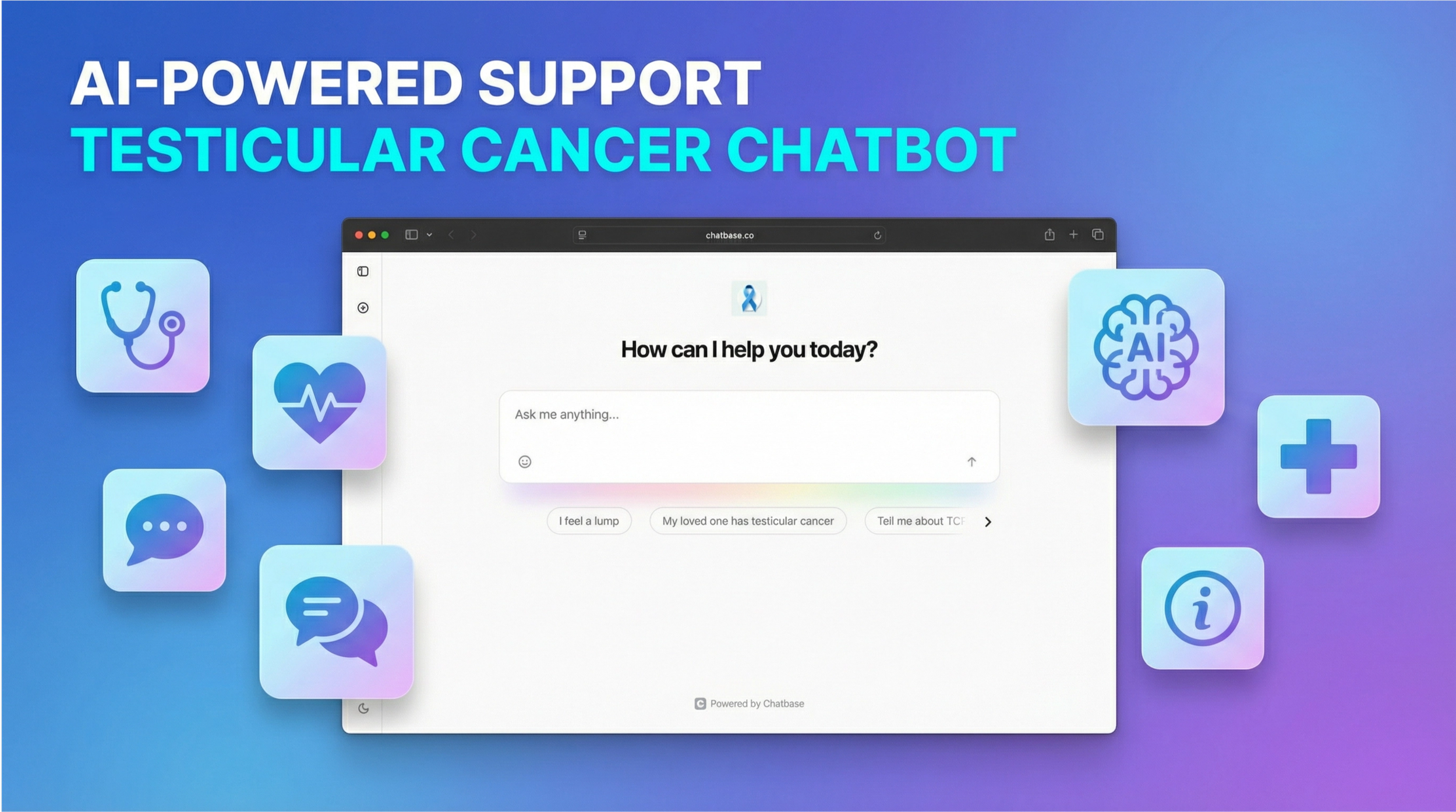
I recently deployed an AI chat agent on TesticularCancer.org using Chatbase.
Not because it is trendy. Not because I think chatbots replace people. And definitely not because I want a nonprofit to look like a tech company.
I did it because this is one of the few tools I have seen that can truly reduce friction for the exact people we exist to serve.
Testicular Cancer Foundation provides education, resources, community connection, and financial aid. But historically, for someone to get what they needed, they had to land on the right page, navigate the menu, interpret a lot of information under stress, and guess the right next step.
That process assumes the user is clear-headed and patient.
That assumption is unrealistic.
So we gave the website a different interface: the ability to ask directly.
Instead of forcing someone to sift through pages, the site can now respond to questions in real time, day or night. This is not a convenience feature. It is access.
People should not have to perform competence to get help
There is another form of gatekeeping we do not talk about enough.
Many systems require users to perform competence in order to receive support. They have to use the right words, sound educated, ask the right way, and stay composed.
AI agents remove that requirement.
You can ask the question exactly the way it appears in your mind. You can ask it again. You can ask it without worrying about judgment. You can ask it at 2:00am when fear is louder than logic.
That matters, because the people under the most stress often feel the most shame about not knowing what to do next.
Agents help restore dignity.
What the agent does and what it does not do
This agent is not a doctor, and we built it accordingly.
It provides educational information. It encourages professional medical care. It does not pretend to diagnose. It routes users toward real TCF resources and next steps.
It does not replace clinicians, human support, or peer community.
What it does replace is the most fragile moment in the user journey: not knowing where to start.
Information is becoming a utility
In the near future, there will be two types of organizations.
The first treats information as content. The second treats information as infrastructure.
Content says, “Here is what we wrote. Good luck.”
Infrastructure says, “Ask what you need. We will guide you.”
AI agents make the second model possible. And once people experience this kind of support, they will not want to go back.
Nobody wants to dig through a website during a crisis. Nobody wants to interpret jargon while scared. Nobody wants to wait days for an email response to a simple question.
They want a direct path from fear to clarity.
Closing thought
Gatekeeping has always been structural. It was never just about withholding information. It was about access, interpretation, and availability.
That structure is collapsing.
When an AI agent can translate jargon, answer instantly, reduce confusion, and guide someone to the right next step, information stops being a privilege.
It becomes what it should have always been: a public utility.
That is why I put an AI agent on TesticularCancer.org.
Not because I am excited about AI.
Because I am excited about a world where people do not have to fight for clarity.
