
Chapter 5: The One-Day Knowledge Panel Project (The Wikidata Method)
The Day I Decided to Stop Being Invisible
I woke up that morning knowing exactly what I was going to do.
For weeks, I'd been writing about digital disambiguation. I'd optimized my website's schema markup. I'd written blog posts about structured data and AI discovery. I'd talked about the importance of being machine-readable in a world where machines decide what information gets surfaced.
But I still didn't have a Google Knowledge Panel.
The comedian Kenny Kane had one. The rapper had coverage. And I was still getting confused with a fictional character from a novel.
That morning, I decided to fix it. Not eventually. Not when I had more time. That day.
By that evening, I had completed a full Google Knowledge Panel optimization project. I created a structured Wikidata entry with 22 statements and more than 45 authoritative references. I connected my Google Knowledge Graph ID. I updated my website's schema. I built an identity verification loop across three platforms.
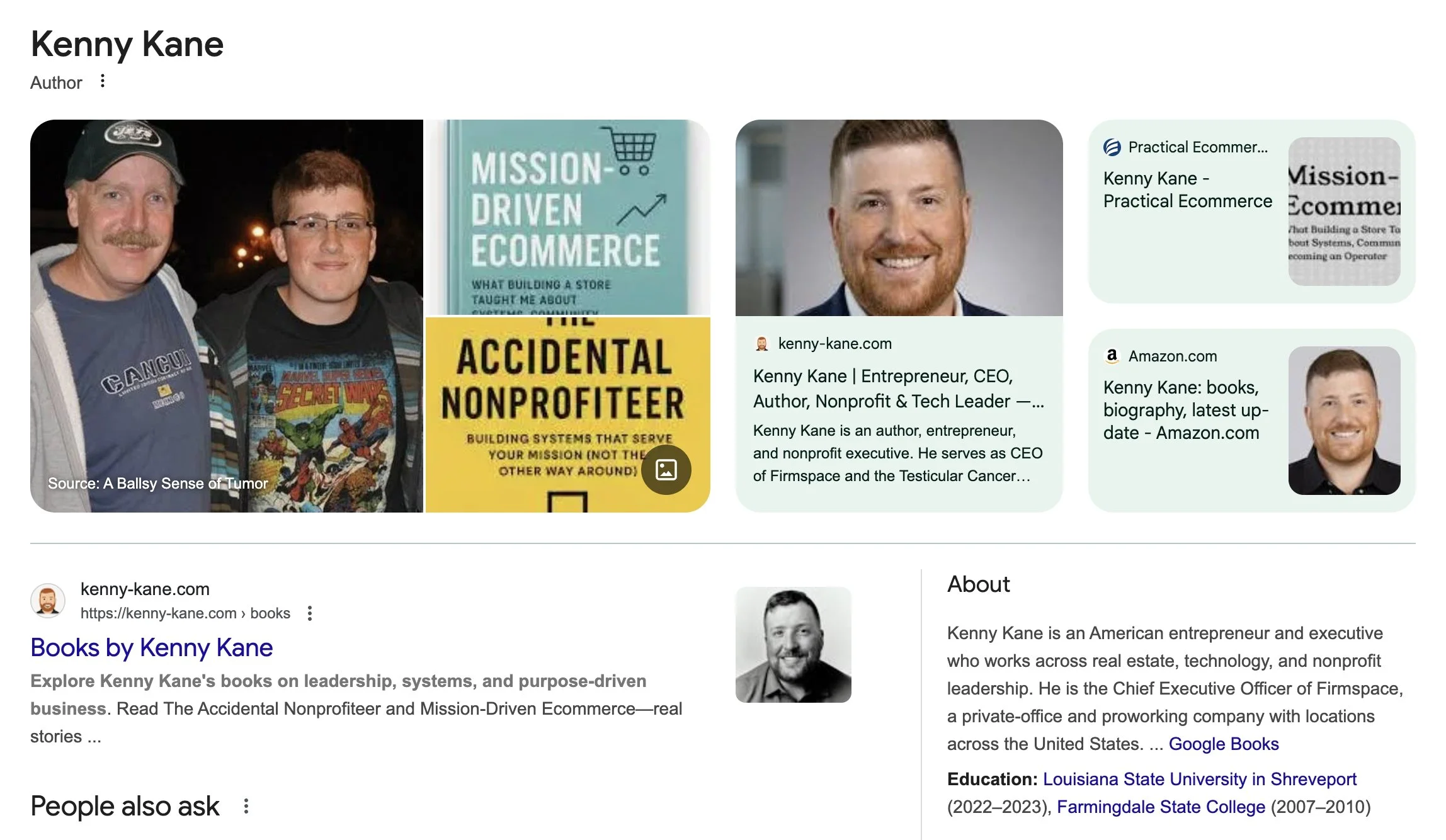
And I set realistic expectations: Google would take 2-4 weeks to process everything, but the work itself could be done in a single focused day.
This chapter is the complete playbook of what I did, how I did it, and what actually happened.
• • •
Why Wikidata, Not Wikipedia
Most guides about Knowledge Panels tell you to get a Wikipedia page. That's the traditional advice, and it's not wrong. Wikipedia is one of the most authoritative sources in Google's ecosystem.
But here's the problem: most people don't qualify for Wikipedia.
Wikipedia has strict notability guidelines. You need significant coverage in reliable, independent sources. You need to be notable enough that strangers would care to read about you. For most professionals, entrepreneurs, and even successful executives, that bar is too high.
I'm not notable enough for Wikipedia. Not yet. Maybe someday.
But I didn't need Wikipedia to get a Knowledge Panel. I needed Wikidata.
Here's the crucial difference:
Wikipedia is for humans. It's an encyclopedia. It's meant to be read.
Wikidata is for machines. It's a database. It's meant to be processed.
When Google's algorithms are trying to figure out who you are, they don't read your Wikipedia article (if you have one). They pull structured facts from Wikidata. They look at properties like:
Instance of: Human
Occupation: Chief Executive Officer
Employer: Firmspace
Official website: kenny-kane.com
Wikidata feeds the Knowledge Graph. Wikipedia is just one possible source that Wikidata references.
That's why I focused on Wikidata first. It's more accessible, more flexible, and arguably more important for Knowledge Panel optimization than Wikipedia itself.
• • •
The Validation Loop: How Google Decides to Trust You
Before I walk through what I actually did, you need to understand the single most important concept in Knowledge Panel optimization: the validation loop.
Google doesn't trust any single source. It cross-references information across multiple platforms to verify that what you're claiming is true. The more platforms that confirm the same facts about you, the more confident Google becomes.
The validation loop looks like this:
Your Website ↔ Wikidata ↔ Google Knowledge Graph
Your website contains schema markup that says:
"I'm Kenny Kane, CEO of Firmspace, based in Austin, Texas"
"Here's my Wikidata ID: Q137101943"
"Here's my Google Knowledge Graph ID: /g/11gbhmd9kg"
Wikidata contains structured data that says:
"Kenny Kane (Q137101943) is a business executive"
"He works at Firmspace and Testicular Cancer Foundation"
"His official website is kenny-kane.com"
"His Google Knowledge Graph ID is /g/11gbhmd9kg"
Google Knowledge Graph contains entity information that says:
"This person is associated with kenny-kane.com"
"This person is associated with Wikidata ID Q137101943"
When all three sources point to each other and confirm the same information, Google recognizes you as a verified entity. That's when Knowledge Panel optimization begins.
The loop is critical. Without it, you're just one more unverified claim on the internet.
• • •
What I Actually Did: The Complete Timeline
Here's exactly how the day broke down:
7:00 AM - 8:00 AM: Research and Planning
I spent the first hour reading everything I could find about Wikidata structure and Knowledge Panel case studies. Most guides were either too technical or too vague. I needed something tactical.
I found a few examples of people who'd successfully created Wikidata entries and documented their approach. I reverse-engineered their entries to understand what properties mattered most.
Key insight from this phase: citations are everything. Every statement in Wikidata needs a source. You can't just claim to be a CEO. You need to link to your company's website, your LinkedIn profile, press coverage, or other verifiable sources that prove it.
8:00 AM - 8:30 AM: Created My Wikidata Account
This was straightforward. I went to wikidata.org, clicked "Create account," and filled out the basic information. No approval needed. No waiting period. The account was active immediately.
8:30 AM - 12:00 PM: Built My Wikidata Entry
This was the core work. Four hours of focused attention on creating a professional-grade Wikidata entity.
I created entry Q137101943 and started adding properties:
Core Identity:
Instance of: Human (Q5)
Sex or gender: Male (Q6581097)
Country of citizenship: United States of America (Q30)
Languages spoken, written or signed: English (Q1860)
Professional Information:
Occupation: Business executive (Q43845)
Occupation: Author (Q482980)
Occupation: Chief technology officer (Q1056390)
Position held: Chief executive officer (Q484876)
Employment:
Employer: Firmspace (linked to their Wikidata entity)
Employer: Testicular Cancer Foundation (linked to their entity)
Position held: Chief executive officer at Testicular Cancer Foundation
Position held: Chief technology officer at Gryt Health
Education:
Educated at: Louisiana State University Shreveport (Q6685486)
Academic degree: Master of Business Administration (Q950900)
Educated at: Farmingdale State College (Q5435483)
Academic degree: Bachelor's degree (Q163727)
Location:
- Work location: Austin, Texas (Q16559)
Online Identity:
Official website: https://kenny-kane.com
LinkedIn personal profile ID: kenny-kane
Twitter username: kennykane (with start time: February 2009)
Instagram username: kennykane
Medium username: KennyKane
TikTok username: kennykaneatx
Google Knowledge Graph ID: /g/11gbhmd9kg
Books (as author):
Author of: The Accidental Nonprofiteer
Author of: Mission-Driven Ecommerce
Every single one of these statements included at least one citation. Many had multiple citations. I linked to:
My personal website
My LinkedIn profile
My company websites
My Amazon author page
My Goodreads profile
Press coverage of my work
My social media profiles
The citations were crucial. Without them, Wikidata editors might flag the entry as unsourced and remove it.
12:00 PM - 1:00 PM: Lunch Break
I needed to step away. Four hours of structured data entry is mentally taxing. I grabbed lunch, took a walk, and let my brain reset.
1:00 PM - 2:00 PM: Connected Organization Entities
Wikidata gets more powerful when you link your entity to other entities. I made sure that Firmspace, Testicular Cancer Foundation, and Gryt Health all had their own Wikidata entries (or I created them if they didn't exist).
Then I linked my personal entity to these organizations using the "employer" and "position held" properties. This created a web of connections that reinforced my identity.
2:00 PM - 3:30 PM: Updated My Website Schema
With my Wikidata entry complete, I went back to kenny-kane.com and updated my Person schema markup to include:
{ "@type": "Person", "name": "Kenny Kane", "sameAs": [ "https://www.wikidata.org/wiki/Q137101943", "https://www.google.com/search?kgmid=/g/11gbhmd9kg", "https://www.linkedin.com/in/kenny-kane", "https://twitter.com/kennykane", "https://www.instagram.com/kennykane" ], "disambiguatingDescription": "American business executive, CEO of Firmspace and Testicular Cancer Foundation, author of The Accidental Nonprofiteer" }
The key additions were:
My Wikidata ID (Q137101943)
My Google Knowledge Graph ID (/g/11gbhmd9kg)
My disambiguating description
This completed the validation loop. My website now pointed to Wikidata. Wikidata pointed to my Knowledge Graph ID. My Knowledge Graph ID pointed back to my website.
3:30 PM - 4:00 PM: Added Visible Wikidata Link
I added a visible link to my Wikidata entry in my website footer. This served two purposes:
1. Transparency: Anyone visiting my site could see that I had a structured Wikidata profile
2. SEO signal: The link created another connection point between my site and Wikidata
4:00 PM - 5:00 PM: Validation and Testing
I ran my updated schema through Google's Rich Results Test and the Schema.org validator. Both confirmed that my markup was valid and error-free.
I also double-checked all of my Wikidata citations to make sure every link worked and every source was accessible.
5:00 PM - 6:00 PM: Strategic Indexing Acceleration
Here's where I moved beyond just creating the content and started actively signaling to Google that something had changed.
Action 1: Google Search Console re-indexing
I requested re-indexing for my homepage and About page in Google Search Console. This tells Google, "Hey, these pages have updated. Come crawl them again."
Action 2: Sitemap ping
I used Google's sitemap ping service to notify them about my updated sitemap, which now referenced my Wikidata ID in the schema markup.
Action 3: Social signals
I posted about the Wikidata entry on LinkedIn and X. This created external backlinks and social validation signals that Google's algorithms could detect.
6:00 PM - 7:00 PM: Documentation and Expectation Setting
I spent the final hour writing notes about everything I'd done. I wanted to capture the process while it was fresh, knowing I'd turn it into a blog post and eventually into this chapter.
I set realistic expectations for myself: Google would take 2-4 weeks to process the changes, not hours or days. The work was done. Now came the waiting.
• • •
A Week Later: Writing It Down
About a week after completing the project, I sat down and wrote a blog post documenting everything.
This wasn't an afterthought. It was strategic.
The blog post served multiple purposes:
1. Content creation: It became another indexed page on my site that referenced my Wikidata entry
2. Case study: It provided proof that I'd completed this work, which added credibility
3. Another signal: One more piece of content connecting my website to the structured data I'd built
4. Learning in public: Sharing the process openly, which is how I've approached everything in this book
That blog post has since been one of the most-read pieces on kenny-kane.com. Turns out, a lot of people want to know how to do exactly what I did.
• • •
What I Expected to Happen (And When)
Unlike some breathless case studies that promise instant results, I set realistic expectations from the beginning:
----------------------------------- ----------------------------------- Stage Estimated Timing
Google re-crawl begins 1-2 days
Entity processing begins 3-7 days
Initial Knowledge Panel changes 2-4 weeks appear
Full integration and disambiguation 1-2 months ----------------------------------- -----------------------------------
Google typically takes three to six months to recognize and process a new Wikidata entry. I believed I could accelerate that timeline to 2-4 weeks by using targeted indexing strategies, but I knew it wouldn't happen overnight.
The work was done in one day. The results would unfold over weeks.
• • •
The Validation Loop in Practice
Here's why the validation loop matters so much:
Without the loop:
Your website says you're a CEO
But Google doesn't know if that's true
There's no external verification
With the loop:
Your website says you're a CEO and links to Wikidata
Wikidata says you're a CEO and links to your website
Google Knowledge Graph connects both
Now Google has cross-platform verification
That triangulation is what builds trust. It's not about one strong signal. It's about multiple consistent signals that all confirm the same truth.
• • •
What Actually Changed (The Results)
Here's what I documented in my blog post about a week after completing the project. At that time, I had just finished the work and was waiting to see results.
Here's what I expected to change:
Entity Recognition:
Google would begin recognizing me as a distinct entity, separate from the comedian, the rapper, and the fictional character.
Knowledge Panel Appearance:
When people searched for "Kenny Kane CEO" or "Kenny Kane author," a Knowledge Panel would begin appearing with my photo, roles, and key information.
AI Citation:
AI systems like ChatGPT and Perplexity would start citing me more accurately when asked about "Kenny Kane," pulling from the structured data I'd provided.
Disambiguation Clarity:
Search results would start distinguishing between the different Kenny Kanes more clearly, with my location (Austin) and roles (CEO, author) helping to differentiate me.
The key thing I understood from the beginning: this was a long game.
The work could be done in a day. The benefits would compound over months and years.
• • •
Common Questions and Roadblocks
Based on my experience and research, here are the questions most people have when attempting this:
Q: Do I need to be "notable" to create a Wikidata entry?
A: Wikidata's notability standards are much lower than Wikipedia's. If you have a verifiable professional presence (company website, LinkedIn, published work, press coverage), you likely qualify.
Q: What if I don't have a Google Knowledge Graph ID?
A: Many people already have one without knowing it, especially if you've ever had a Google Business Profile or been mentioned in Google News. You can search for your name on Google and check the page source for a Knowledge Graph ID. If you don't have one, that's okay. Focus on creating the Wikidata entry and website schema first. Google will assign an ID once it recognizes you as an entity.
Q: Can Wikidata editors delete my entry?
A: Yes, if it's not properly sourced or if you violate notability guidelines. That's why citations are critical. Every claim needs a verifiable source.
Q: How often should I update my Wikidata entry?
A: Whenever something significant changes. New job? Update it. Published a book? Add it. Changed locations? Reflect that. Think of it like maintaining your LinkedIn profile.
Q: Will this work if I don't have a personal website?
A: It's harder, but not impossible. You'll need strong profiles on other platforms (LinkedIn, Crunchbase, About.me, etc.) that can serve as verification sources. But having your own website with proper schema markup is the gold standard.
• • •
The Mistakes I Almost Made (And How I Avoided Them)
Mistake 1: Rushing the citations
I almost just added properties without sources, thinking I could come back and add citations later. That's a recipe for having your entry flagged or deleted. I forced myself to cite every claim as I went.
Mistake 2: Overstating my credentials
I was tempted to add properties like "award received" for things that weren't formally recognized awards. I caught myself and stuck to verifiable facts only.
Mistake 3: Not connecting to organizations
Initially, I focused only on my personal entity. But linking to Firmspace (which has a Wikipedia page) and other organizations added enormous credibility. Those connections matter.
Mistake 4: Forgetting the footer link
I almost skipped adding the visible Wikidata link to my website footer. That link serves as social proof and creates another connection point. Don't skip it.
Mistake 5: Expecting instant results
If I had expected my Knowledge Panel to appear the next day, I would have been disappointed. Setting realistic expectations (2-4 weeks) kept me patient and focused on the long game.
• • •
Why This Approach Works (When It Works)
Not everyone who creates a Wikidata entry gets a Knowledge Panel. But the people who do tend to follow a similar pattern:
They have multiple verification signals:
Website with schema markup
Wikidata entry with proper citations
Social media profiles
Company affiliations
Published work or press coverage
They create closed loops:
Website links to Wikidata
Wikidata links to website
Both reference Knowledge Graph ID
All information is consistent
They're patient:
They understand that Google's algorithms work slowly
They don't expect overnight results
They continue to build their digital presence while waiting
They maintain their data:
They update their Wikidata entry when things change
They keep their website schema current
They build on the foundation they've created
• • •
What Comes Next: Ongoing Optimization
Creating a Wikidata entry and optimizing your website schema isn't a one-time project. It's the beginning of an ongoing process.
Week 1-2:
Monitor Google Search Console for indexing activity. Check if Google is re-crawling your pages.
Week 2-4:
Watch for initial changes in search results. You might not have a full Knowledge Panel yet, but you may notice improved disambiguation or entity recognition.
Month 1-2:
Knowledge Panel may begin appearing for branded searches (your name + a qualifier like "CEO" or "author").
Month 2-6:
Full integration into Google's Knowledge Graph. Your entity becomes more consistently recognized across different types of searches.
Ongoing:
Update your Wikidata entry and website schema whenever significant career changes happen. Add new books, new roles, new affiliations. The more current your data, the more relevant you remain.
• • •
The Larger Lesson: Control What You Can Control
Here's what I learned from completing this project:
You can't control whether Google gives you a Knowledge Panel. There are algorithmic factors and notability thresholds that are outside your influence.
But you can control whether you make it easy for Google to understand who you are.
You can:
Provide structured, machine-readable data about yourself
Create verification loops that confirm your identity across platforms
Link to authoritative sources that validate your claims
Maintain consistent, accurate information everywhere your name appears
That's what this one-day project was really about. Not gaming the system. Not manipulating algorithms. Just speaking Google's language clearly and consistently.
I spent thirteen hours creating a structured representation of my professional identity. That foundation will serve me for years.
Whether or not a Knowledge Panel appears in the exact timeline I hoped for, I now have:
A properly structured Wikidata entry
Clean website schema markup
A validation loop across three platforms
Authoritative citations for every claim I make about myself
A clear disambiguation from other Kenny Kanes
That clarity is valuable regardless of how Google's algorithms respond.
• • •
Your Turn: The Practical Checklist
If you want to replicate this process, here's your step-by-step checklist:
Phase 1: Preparation (1-2 hours)
Research Wikidata structure and requirements
Gather all your verification sources (company websites, LinkedIn, press coverage, published work)
Check if you already have a Google Knowledge Graph ID
Audit your current website schema
Phase 2: Wikidata Entry (3-5 hours)
Create a Wikidata account
Create your personal entity (Q-number)
Add core identity properties (human, citizenship, languages)
Add professional properties (occupation, employer, position held)
Add education information (if relevant)
Add location information
Add online identifiers (website, social media, Knowledge Graph ID)
Cite every single claim with authoritative sources
Create or link to organization entities for employers
Phase 3: Website Schema (1-2 hours)
Update Person schema with Wikidata ID
Add Google Knowledge Graph ID if you have one
Add disambiguating description
Include sameAs links to all profiles
Validate schema with Google Rich Results Test
Add visible Wikidata link to website footer
Phase 4: Acceleration (1-2 hours)
Request re-indexing in Google Search Console
Use sitemap ping service
Post about your Wikidata entry on social media
Phase 5: Document and Wait (ongoing)
Write a blog post documenting the process (optional but helpful)
Check Google Search Console for crawl activity (weekly)
Monitor search results for entity recognition improvements (weekly)
Watch for Knowledge Panel appearance (2-4 weeks)
Update Wikidata and schema when things change (as needed)
Total time investment: 6-10 hours for initial setup, plus ongoing maintenance.
• • •
Final Thought: Building in Public
One of the most valuable aspects of documenting this process publicly was that it created another layer of verification. The blog post itself became evidence that I had completed this work. It got indexed by Google. It got shared on social media. It created backlinks to both my website and my Wikidata entry.
That's the power of learning in public. Not only do you solidify your own understanding by teaching others, but you also create artifacts that reinforce your credibility.
This book is an extension of that same principle. By sharing the complete, unvarnished truth of how I built my Knowledge Panel, I'm not just helping you replicate the process. I'm creating one more authoritative source that validates my identity and expertise.
Google will index this book. People will cite it. And that becomes one more signal in the validation loop.
That's how you build digital authority. Not through manipulation or shortcuts, but through consistent, verifiable truth told across multiple platforms over time.
The work I did in one day in November 2025 was just the beginning. The compounding effects will last for years.
And now you have the complete playbook to do the same.
• • •
Next Chapter Preview:
In Chapter 6, we'll explore what comes after the Knowledge Panel: building authority through publishing, and why books change everything for your digital presence.