
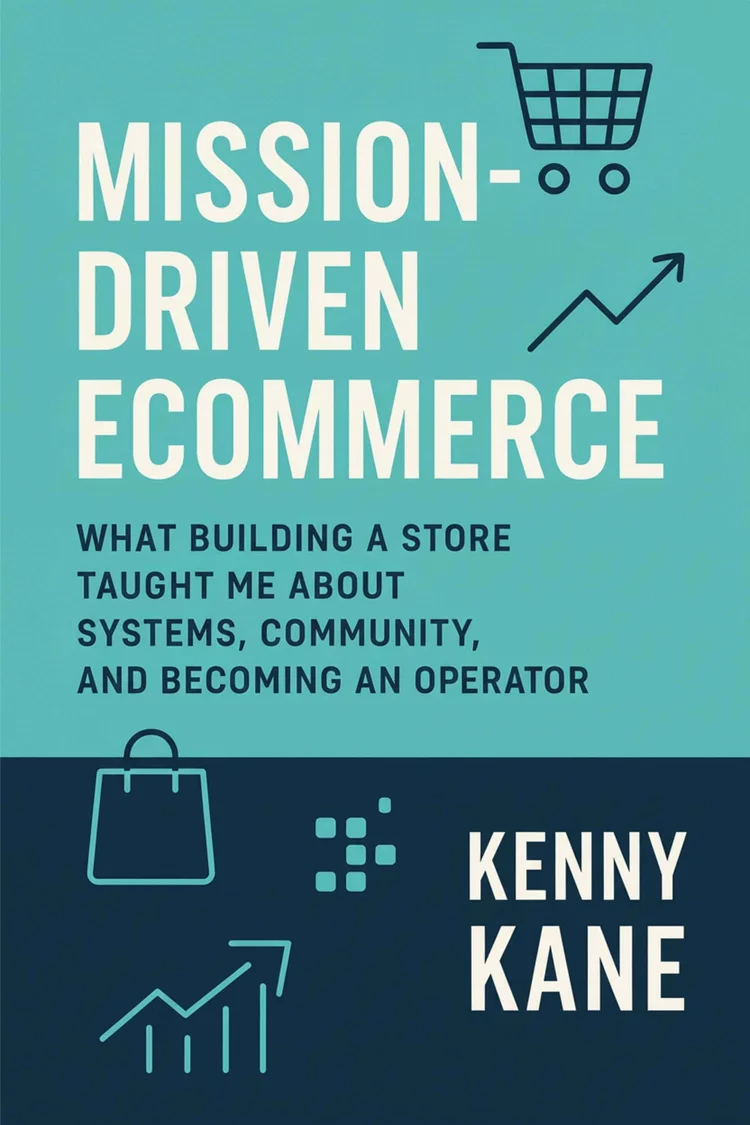
Mission-Driven Ecommerce
What Building a Store Taught Me About Systems, Community, and Becoming an Operator
At Stupid Cancer I built and ran an online store that started with a single twenty-dollar t-shirt and grew into a six-figure operation funding programs. This book is the record of how that was actually done: inventory and fulfillment, pricing, vendor relationships, the software stack, the volunteer labor, and the decisions that only look obvious afterward.
It is an operating account of one store over several years, written for people running something small with more work than staff.
What It's About
A store is an operating system with a storefront attached.
The visible part of a merchandise program is the product. The part that determines whether it survives is everything behind it: how orders are received and filled, how stock is counted, who answers the email, what happens during a spike, and what is written down well enough that the next person can run it.
The store worked because those things existed, and it kept working through staff changes because most of them were documented rather than held in someone's head. That is the part of the story I find useful now, and it is the part this book spends the most time on.
There is no growth framework here and no claim that the approach generalizes. It is one operation, described closely enough to be useful to someone building a comparable one.
The systems that outlast their operators are the ones somebody bothered to write down.
What's Inside
The store, from first shirt to hand-off.
-
Starting with what you have
The first product, the first hundred orders, and the decisions made with no budget and no forecast.
-
Inventory, fulfillment, and vendors
Stock counts, print runs, shipping, returns, and the vendor relationships that determine what is actually possible in a given month.
-
Community as a distribution channel
Why the store grew through the people it served rather than through advertising, and what that changes about pricing, timing, and product decisions.
-
Automation and the software stack
What was worth automating, what was not, and where tooling reduced the work versus adding a system somebody had to maintain.
-
Documentation and hand-offs
The written procedures that let the store change hands, and what did not transfer because it was never recorded.
Who It's For
People running a small operation with more work than staff.
The book assumes a reader closer to the work than to the strategy deck.
- Nonprofit staff running earned-revenue programs alongside their actual jobs
- Founders and operators building a store without a team behind it
- People inheriting an operation someone else built and left
- Anyone deciding what to document before they are the only one who knows
Published Elsewhere
An excerpt in Practical Ecommerce.
Practical Ecommerce published an excerpt from the book. I wrote a regular column for the publication during the years the store was running, which makes that archive a contemporaneous record of the operating decisions rather than a retrospective account of them.
Where It Sits
The second of three.
Each of my books describes the same failure from a different angle: capability, or knowledge, or identity ends up living somewhere fragile, and holds only as long as someone is there to explain it. This one takes a single operation and follows it closely enough to see where the fragility actually was.
In August 2026 I began doctoral study at Texas State University's McCoy College of Business. My research interests are in organizational durability and executive dependency: why execution capacity concentrates in individuals, and what documentation, process design, and technology actually transfer when those individuals leave. These books are the practitioner record that came first.
The Accidental Nonprofiteer. Building the systems a small organization runs on, and what happens to them when people leave.
Read more →Own Your Name. The same durability problem applied to a person's public record: structured data, sourced entities, and maintenance.
Read more →About the Author
Kenny Kane runs organizations and studies what makes them durable.
He is CEO of Firmspace, a premium private office and executive suite company with locations in Austin, Denver, Houston, and Atlanta; CEO of the Testicular Cancer Foundation; and Co-Founder, Board Member, and Chief Technology Officer of Gryt Health.
He has spent more than fifteen years in operating roles across real estate, health technology, and the nonprofit sector, including six years at Stupid Cancer, where he joined as an intern in 2010 and left as Chief Operating Officer in 2016. He is a doctoral student at Texas State University's McCoy College of Business and lives in Austin, Texas.

Details
Editions and listings.
- PublishedOctober 16, 2025
- FormatsKindle, Apple Books, Google Play
- IdentifiersASIN B0FWMFSFRC
- Excerpt
- Reviews
- Author pages
- Verify
Review copies and excerpts.
For a review copy, permission to republish an excerpt, or a conversation about the material, get in touch.